
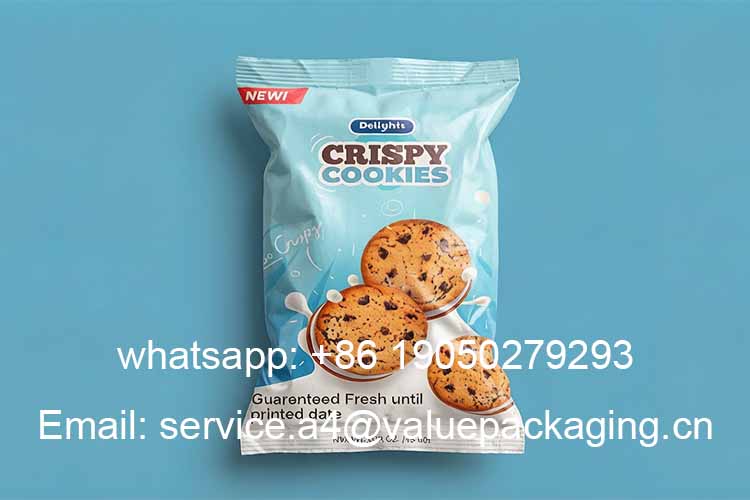
Cookies are a popular snack enjoyed worldwide, valued for their rich flavor, variety of textures, and convenience. From crispy butter cookies to soft baked varieties, cookies are widely consumed in retail, gifting, and food service applications. Due to their low moisture content and high fat composition, cookies are sensitive to humidity, oxygen, and physical breakage. As a result, cookie packaging plays a key role in preserving texture, preventing rancidity, and maintaining product appearance. At the same time, brands are increasingly exploring eco-friendly cookie packaging to reduce environmental impact.
1. Common Cookie Packaging Solutions
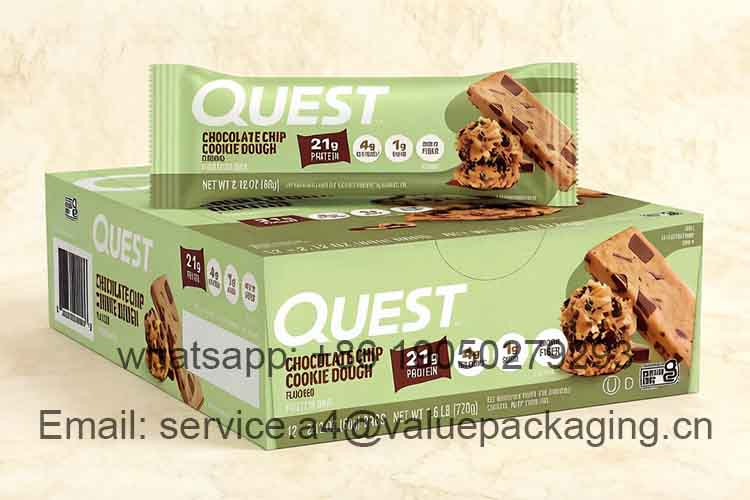
Cookie packaging must protect the product from moisture, oxygen, and mechanical damage while ensuring convenience and strong shelf presentation. The most commonly used formats include:
Pillow bags (some with inner trays)
Pillow-style cookie bags are commonly used for both retail and bulk packaging. Some designs include a small plastic tray inside to protect fragile cookies from breakage. The pillow shape is simple, cost-effective, and allows efficient stacking and transport.
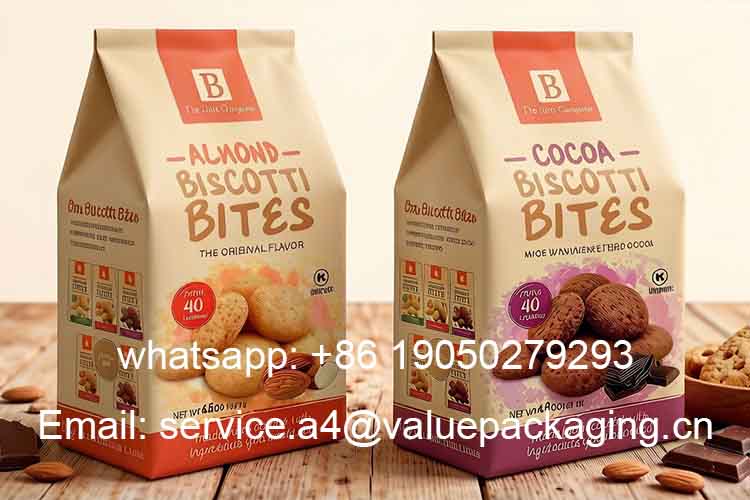
Flat bottom bags
Flat bottom cookie packaging bags are often used for larger quantities or premium products. They stand more securely on shelves and provide a structured, attractive appearance, making them suitable for retail display and gifting.
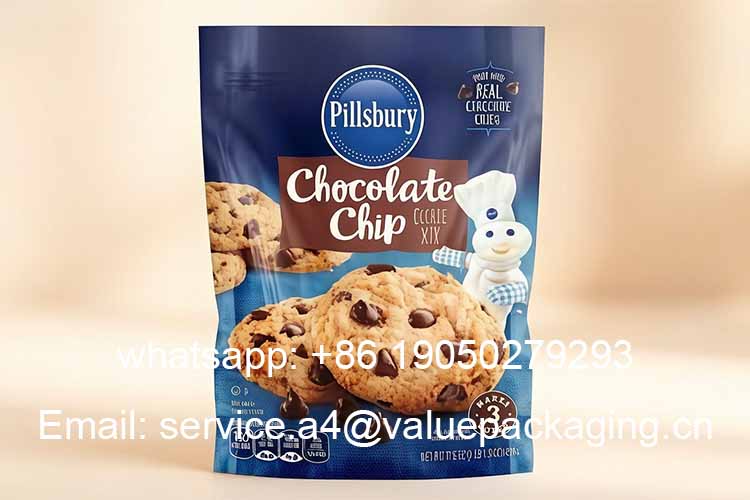
Stand-up pouches with resealable zippers
These cookie pouches are widely used for convenience and repeated use. The resealable zipper allows consumers to open and close the package multiple times, helping maintain freshness after opening. The upright design also improves shelf presence and storage efficiency.
Transparent ready-to-eat bags
Clear, flexible cookie bags are used when brands want the product to be visible. These bags are typically used for ready-to-eat products or cookies with a short shelf life of only a few days. They allow consumers to directly see the product while providing basic protection from moisture and handling.
Single-serve small packs
Individual cookie sachets or small packs are ideal for portion control, on-the-go consumption, or multipack formats. These are commonly used in food service, airlines, and retail multipacks, ensuring each portion remains fresh and easy to use.
2. Traditional Materials Used in Cookies
Cookies have specific packaging needs depending on their texture and composition. Key considerations include:
- Moisture control
Cookies can lose their crispness when exposed to humidity, or dry out further in very low moisture environments. A stable moisture barrier is essential. - Oxidation protection
The fats and oils in cookies are prone to oxidation, which can lead to rancid flavors. Oxygen barrier performance is important for shelf life. - Physical protection
Cookies are fragile and easily broken. Packaging must provide sufficient compression resistance, especially during transport. - Grease resistance
Due to butter or oil content, packaging materials should resist grease migration and maintain integrity. - Sealing performance
A reliable seal is necessary to protect against external air and moisture, particularly for multi-pack or resealable formats.
To meet these requirements, cookie packaging materials must provide a balance of barrier performance, strength, and sealing reliability.
Common materials include:
- PET film
- VMPET film
- LDPE film
- BOPP film
- Kraft paper
- Metallized PET film
In cookie packaging, BOPP film is especially suitable for short shelf life products and small portion packs. For freshly baked cookies or high-turnover items, the required barrier performance is relatively moderate, making BOPP a practical and cost-effective choice. It provides sufficient moisture protection to maintain crispness over a few days while avoiding overengineering the packaging structure.
BOPP is also widely used in small, single-serve cookie packs due to its excellent machinability and stiffness. It runs smoothly on high-speed flow wrap lines, making it ideal for individually wrapped cookies in multipacks or food service applications. In addition, its natural grease resistance helps handle butter-rich cookies without compromising package appearance.
3. Sustainability Challenges in Conventional Cookie Packaging
Different material combinations are used in cookie packaging depending on product type, shelf life, and positioning. For example, premium cookies may require higher barrier materials, while everyday products focus on cost efficiency.
| Application Type | Key Features | Suitable Shelf Life |
|---|---|---|
| Ready-to-Eat | High transparency for product visibility; suitable for simple wrapping; limited moisture and oxygen barrier | Immediate consumption or within a few days, e.g., bakery cookies, fresh-packed cookies |
| Short Shelf Life | Good grease resistance and heat sealing; suitable for flow wrap and small packs; cost-effective with basic protection | Freshly baked or fast-moving retail cookies, typically consumed within weeks |
| Medium Shelf Life | Improved moisture and oxygen barrier; better structure to reduce breakage; enhanced printability for branding | Standard retail cookies requiring stable texture and moderate distribution time |
| Long Shelf Life | High barrier against oxygen and moisture; suitable for nitrogen flushing or tray packaging to prevent breakage | Export products or cookies with long distribution cycles and extended shelf life |
Ready-to-Eat Applications
Single-layer BOPP
This structure is commonly used for freshly baked or ready-to-eat cookies that are intended for immediate consumption. It provides excellent clarity, allowing the product to be directly visible, which is important for bakery-style or handcrafted cookies. BOPP also offers good stiffness and grease resistance, helping maintain a clean package appearance. However, its barrier to moisture and oxygen is limited, making it suitable only for short-term use, typically within a few days.
Short Shelf Life Applications
BOPP / CPP
Widely used for individually wrapped cookies or small packs, especially in flow wrap applications. This structure provides good heat sealing performance and grease resistance, which is important for butter-rich cookies. It offers basic moisture protection to help maintain crispness for short periods, making it suitable for fast-moving retail products.
BOPP / PE
A simple and cost-effective option for high-volume cookie packaging. It provides basic protection against external moisture and handling, but limited oxygen barrier. Typically used for economy products or cookies with shorter shelf life requirements.
Medium Shelf Life Application
BOPP (Matte) / VMPET / PE
This structure combines visual appeal with improved barrier performance. The matte BOPP layer enhances shelf presentation, while VMPET helps reduce moisture ingress and slows down oxidation of fats. It is suitable for standard retail cookies that require a balance between product protection, branding, and cost.
PET / PE
Compared with BOPP-based structures, PET adds mechanical strength and better dimensional stability. This makes it useful for cookie packaging where durability during transport is important, especially for products that are more fragile or packed in larger formats.
Long Shelf Life Applications
PET / VMPET / PE
This is a commonly used high-barrier structure for cookies requiring extended shelf life. It provides strong protection against both moisture and oxygen, helping maintain crisp texture and prevent rancidity of oils. It is suitable for export products or cookies distributed over longer periods.
PET / AL / PE
For applications requiring maximum protection, aluminum foil can be introduced as a barrier layer. This structure offers excellent resistance to moisture, oxygen, and light, making it suitable for premium cookies or products with sensitive ingredients. However, due to higher cost and reduced flexibility, it is typically used selectively.
While these multilayer laminates provide effective protection, they are difficult to recycle due to the combination of different materials. As a result, many conventional cookie bags and pouches are treated as mixed plastic waste after disposal.
4. Recyclable Mono Material Cookie Packaging
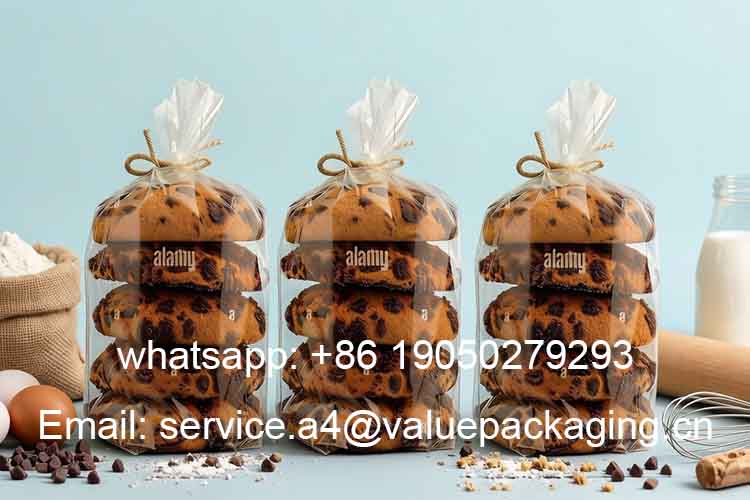
To improve sustainability, mono material packaging is gaining attention. By using materials from the same polymer family, these recyclable cookie pouches are more compatible with existing recycling systems, reducing the challenges associated with mixed-material laminates.
Common PE-based materials for popcorn include:
These polyethylene-based materials are particularly suitable for cookie packaging due to their good moisture barrier performance and excellent heat sealing properties. This helps maintain crispness while ensuring reliable sealing for multi-use or larger packs.
Common PP-based materials include:
Polypropylene-based structures are often used for flow wrap and small cookie packs due to their stiffness, clarity, and smooth machinability. They are especially suitable for individually wrapped cookies or high-speed packaging lines.
Typical recyclable structures include:
- BOPP/VMCPP
- MDOPE/LDPE
- BOPE/LDPE
- MDOPE/BOPE/LDPE
- BOPP/VMCPP
- ABOPP/VMCPP
These structures provide sufficient moisture barrier and sealing performance while improving recyclability compared with traditional multilayer packaging.
5. Compostable Cookie Packaging
Another emerging direction is compostable packaging made from renewable materials such as PLA, PBAT, and cellulose. These materials are designed to break down under composting conditions, offering an alternative to conventional plastics.
Common compostable materials include:
In practical applications, these materials are often laminated to improve strength, sealing performance, and barrier properties, especially for products like cookies that require both moisture control and grease resistance.
Typical compostable structures include:
- Kraft Paper/PLA+PBAT Membrane
- Cellulose/PLA+PBAT Membrane
- Metallized Paper/PLA+PBAT Membrane
- Cellulose/Metallized Cellulose/PLA+PBAT Membrane
- Kraft Paper/Metallized Cellulose/PLA+PBAT Membrane
For cookies, compostable packaging must still provide adequate moisture barrier and grease resistance to maintain texture and prevent quality loss. Since cookies are sensitive to humidity and contain natural oils, insufficient barrier performance may lead to softening, flavor changes, or oil migration.
In addition, sealing performance is a key factor for compostable laminates. Compared with conventional plastics, some bio-based materials have narrower heat sealing windows, requiring optimized processing conditions to ensure package integrity during storage and transportation.
Barrier Properties of Compostable Laminates
| Biodegradable Foil Laminate | WVTR(g/m2/24hr) | OTR (cc/m2/24hr) |
| Cellulose20/Metallized Cellulose20/PLA+PBAT60 | 18 | 2.1 |
| Cellulose20/Metallized Cellulose20/BOPLA40 | 19 | 2.2 |
| K-Cellulose22/Metallized Cellulose20/PLA+PBAT60 | 8 | 0.5 |
| Metallized Paper 69g/Cellulose30/PLA+PBAT60 | 5.6 | 1.12 |
| Cellulose30/Metallized Paper69g/PLA+PBAT60 | 8.9 | 1.1 |
These values indicate that while fully compostable structures may not match the high barrier performance of aluminum-based laminates, they can still meet the requirements of short to medium shelf life cookie products when properly designed.
For higher-performance needs, metallized or coated compostable layers are often preferred, as they help slow down moisture ingress and oxygen exposure, preserving crispness and flavor stability over time.
6. Conclusion
As consumer demand for both quality and sustainability increases, cookie packaging is evolving toward more environmentally responsible solutions. Recyclable cookie pouches improve compatibility with recycling systems, while compostable packaging offers an alternative approach to reducing waste.
At the same time, effective packaging must continue to protect cookies from moisture, oxygen, and physical damage to preserve texture and flavor. By balancing sustainability with performance, brands can deliver high-quality products while meeting modern environmental expectations.