
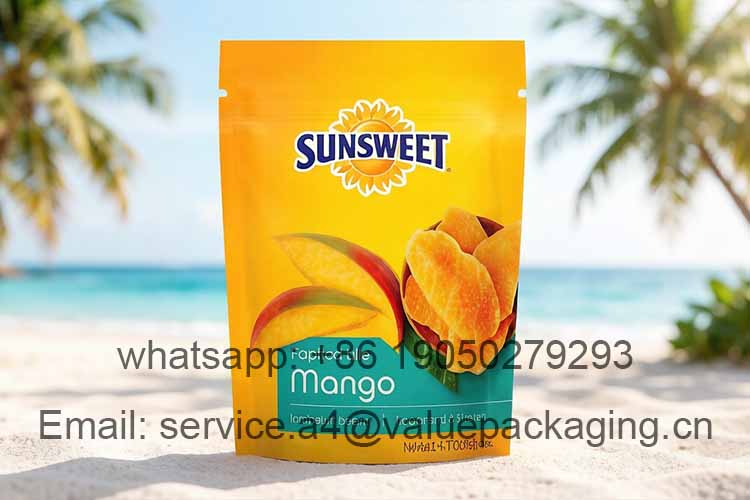
As consumer demand for natural and minimally processed snacks continues to grow, dried mango has become a widely recognized product in both domestic and international markets. With its naturally high sugar content, soft texture, and vibrant color, dried mango is commonly used in retail snacks, bakery applications, and healthy food formulations.
However, from a packaging perspective, dried mango differs significantly from low-moisture snacks such as cookies or crackers. Its intermediate moisture level and sugar-rich composition create a more complex stability profile, requiring a more carefully designed packaging solution.
Product Characteristics and Packaging Challenges
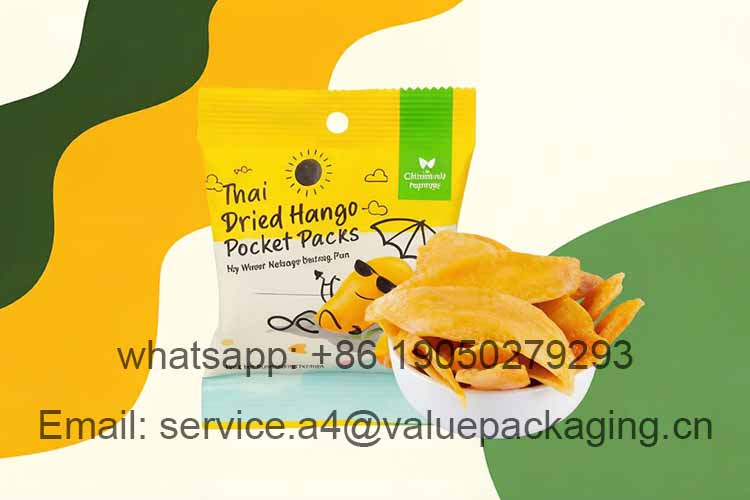
Dried mango packaging focuses on maintaining texture stability, preventing stickiness, and ensuring convenience during repeated use. The most commonly used formats include:
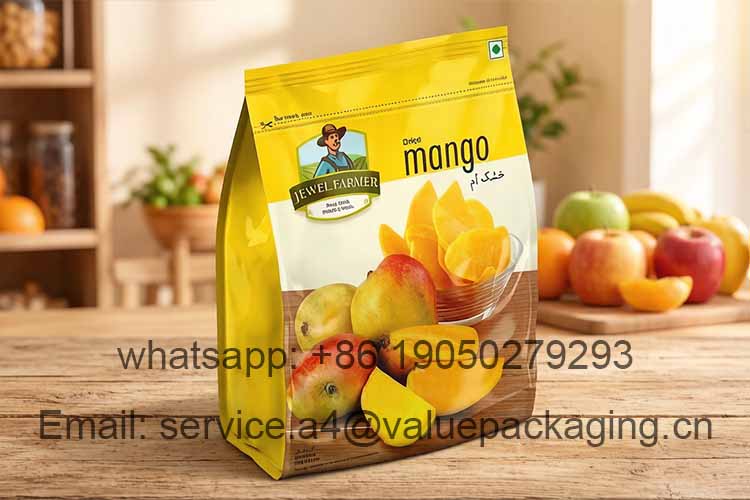
Stand-up pouches with resealable zippers
These dried mango pouches are widely used in retail. The resealable zipper helps reduce moisture exposure after opening, which is important for preventing the product from becoming sticky or clumping together. The stand-up structure also enhances shelf presentation while making the package easy to store and handle.
Flat bottom bags
Flat bottom bags are often used for larger size dried mango products. They provide excellent stability and a more premium appearance, making them suitable for both retail display and home storage. The structured shape also improves space efficiency during transportation and stacking.
Small-size pillow pouches
Pillow pouches are commonly used for small portion dried mango packaging. They are simple, cost-effective, and efficient for high-speed production. This format is ideal for single-serve or low-weight products, offering convenience for on-the-go consumption while keeping packaging costs low.
Small-size resealable pouches
For slightly larger small-size packs, resealable pouches are increasingly popular. They combine portion control with the added benefit of reclosure, allowing consumers to consume the product in multiple servings without exposing it to moisture each time. This format is particularly suitable for premium or convenience-focused retail products.
Many dried mango pouches are designed with a hang hole, often referred to as a Euro hole or airplane hole, to enable easy hanging display in retail environments. This feature improves product visibility and allows better use of vertical shelf space, especially in stores with limited display areas.
Common Flexible Packaging Structures for Dried Mango
| Component | Typical Range (%) | Impact on Packaging |
|---|---|---|
| Moisture | 12 – 20 | Affects texture stability and risk of stickiness or microbial growth |
| Natural Sugars | 60 – 75 | High sugar content leads to surface stickiness and potential adhesion to films |
| Dietary Fiber | 5 – 10 | Contributes to structure but has limited impact on packaging |
| Organic Acids | 1 – 3 | May influence flavor stability and slight interaction with materials |
| Trace Lipids | < 1 | Low fat content, but minor oxidation may still occur |
| Vitamins (e.g. Vitamin C, A) | Trace levels | Sensitive to oxygen and light, affecting color and nutrition |
Based on these characteristics, dried mango packaging must meet several critical performance criteria:
- Moderate to High Moisture Barrier
A stable moisture barrier is essential to prevent both moisture ingress and internal moisture redistribution. - Controlled Oxygen Barrier
A medium to high oxygen barrier helps maintain color and flavor, especially for products with longer shelf life. - Anti-Stick and Seal Reliability
Packaging structures should minimize inner surface adhesion and ensure strong, contamination-resistant seals. - Mechanical Strength
Flexible packaging must withstand handling and transportation without deformation or puncture, particularly for irregularly shaped mango slices.
The most commonly used materials include:
- PET film
- VMPET film
- LDPE film
- BOPP film
- Kraft paper
- Metallized PET film
- AlOx and SiOx coated PET film
Compared with products such as nuts or fried snacks, dried mango places a different emphasis on packaging performance. Nuts are rich in lipids and highly prone to oxidation, which can quickly lead to rancidity and off-flavors. As a result, they typically require very high oxygen barrier materials.
In contrast, dried mango contains very low fat content. Although oxidation still occurs, it mainly affects color and flavor gradually rather than causing rapid spoilage. Therefore, extremely high oxygen barrier is not always necessary for dried mango packaging.
Instead, the primary focus is on moisture control and reducing stickiness caused by sugar migration. In practical applications, structures such as PET / VMPET / PE are widely used, as they provide a balanced combination of moisture protection, sufficient oxygen barrier, and cost efficiency.
Sustainability Challenges in Conventional Dried Mango Packaging
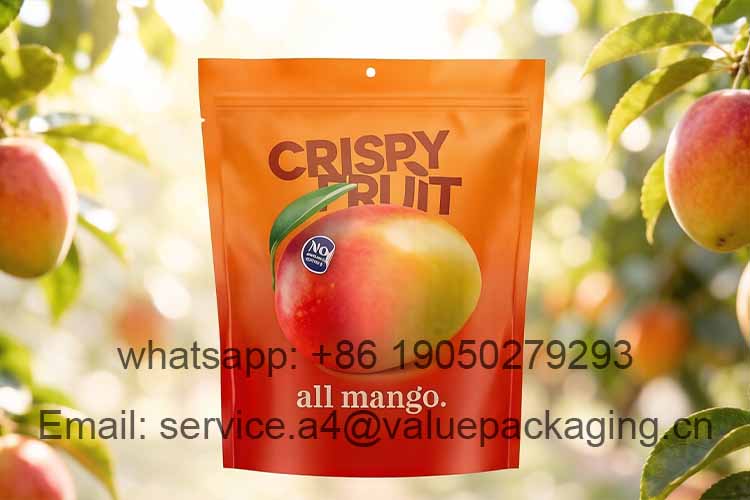
Standard Retail Packaging:
Metallized films such as VMPET provide a balanced level of oxygen and moisture barrier at a lower cost than aluminum foil. These structures help maintain texture stability and reduce the risk of stickiness caused by moisture absorption, while keeping packaging costs under control. They are widely used for everyday retail dried mango pouches with medium to long shelf life.
Cost-Effective Alternatives:
- PET / LDPE
- BOPP / VMCPP
- BOPP / CPP
For cost-sensitive applications, more economical laminate structures are often adopted for dried mango packaging, especially for products with short shelf life or fast market turnover. These solutions typically offer reliable heat sealing and good processability, while providing a basic level of moisture and oxygen protection. Although their overall barrier performance is lower than metallized PET-based laminates, they are widely used in bulk distribution and value-oriented retail formats, where cost efficiency and sufficient protection are the primary considerations.
Transparent or Window Packaging:
- PET / AlOx-PET / PE
- PET / SiOx-PET / PE
Transparent coated films allow product visibility, which helps highlight the natural color and texture of dried mango. AlOx-PET and SiOx-PET provide effective oxygen and moisture barriers while maintaining clarity, offering a balance between shelf appeal and functional protection.
Kraft Paper Laminates:
Kraft paper laminates create a natural and premium appearance, while improving stiffness for better shelf presentation. When combined with aluminum, metallized films, or coated barrier layers, they enhance overall protection while supporting a more sustainable packaging image.
Recyclable Mono-Material Dried Mango Packaging
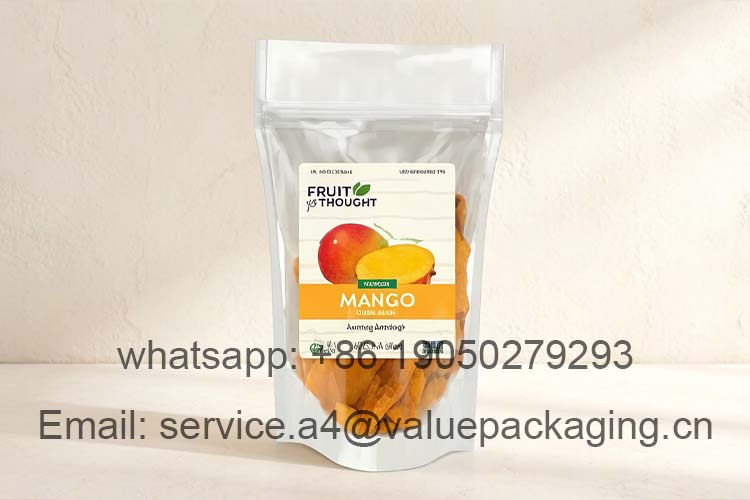
To improve recyclability, the flexible packaging industry is increasingly shifting toward mono-material solutions for dried mango. By using films from the same polymer family, such as polyethylene (PE) or polypropylene (PP), these structures are more compatible with existing recycling systems while still providing the necessary protection against moisture, oxygen, and handling stress.
For dried mango, moisture control is particularly important due to its hygroscopic nature and sugar content. Therefore, recyclable structures must prioritize stable moisture barrier while maintaining sufficient oxygen protection to preserve color and flavor.
Common PE-based materials used in dried mango packaging include:
Common PP-based materials include:
By combining films within the same polymer family, manufacturers can develop recyclable pouches that offer good sealing performance, mechanical strength, and balanced barrier properties. Compared with conventional multi-material laminates, these solutions are easier to recycle while still maintaining product stability.
Typical recyclable pouch structures for dried mango include:
- BOPP/VMCPP
- MDOPE/LDPE
- BOPE/LDPE
- MDOPE/BOPE/LDPE
- BOPP/VMCPP
- ABOPP/VMCPP
These mono-material structures help control moisture uptake, reduce stickiness caused by sugar migration, and maintain product texture during storage and transportation. They provide a practical balance between environmental responsibility and functional performance, especially for products with moderate shelf life requirements.
Compostable Dried Mango Packaging
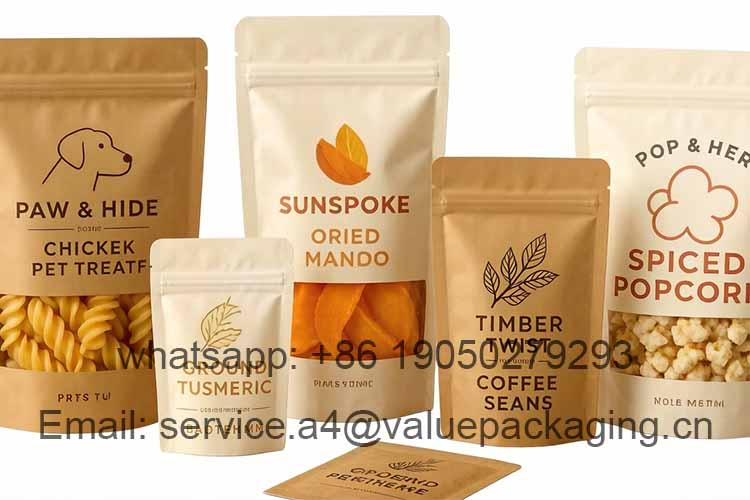
Another growing direction in sustainable dried mango packaging is the use of compostable flexible materials designed to degrade under industrial composting conditions. These materials are typically derived from renewable resources and can reduce long-term environmental impact compared with conventional plastic packaging.
However, compared with low-moisture snacks, dried mango presents additional challenges for compostable packaging due to its sensitivity to humidity and tendency to become sticky. As a result, material selection and structure design must carefully balance environmental performance with functional protection.
Common compostable materials used in dried mango packaging include:
In practical applications, these materials are often laminated to improve mechanical strength, sealing reliability, and barrier performance. Coatings or metallized layers may also be introduced to enhance resistance to moisture and oxygen, which is critical for maintaining product quality over time.
Typical compostable pouch structures for dried mango include:
- Cellulose/PLA+PBAT Membrane
- Cellulose/Metallized Cellulose/PLA+PBAT Membrane
- Kraft Paper/Metallized Cellulose/PLA+PBAT Membrane
- Kraft Paper/Cellulose/PLA+PBAT Membrane
- Kraft Paper/Cellulose/PBS Membrane
- Metallized Paper/Cellulose/PLA+PBAT Membrane
For dried mango, compostable packaging must provide a stable moisture barrier to prevent clumping and surface stickiness, while also offering sufficient oxygen protection to slow down color changes. Compared with traditional high-barrier laminates, these materials typically have lower barrier performance, which makes them more suitable for products with shorter shelf life or controlled distribution conditions.
Barrier Properties of Compostable Laminates
| Biodegradable Foil Laminate | WVTR(g/m2/24hr) | OTR (cc/m2/24hr) |
| Cellulose20/Metallized Cellulose20/PLA+PBAT60 | 18 | 2.1 |
| Cellulose20/Metallized Cellulose20/BOPLA40 | 19 | 2.2 |
| K-Cellulose22/Metallized Cellulose20/PLA+PBAT60 | 8 | 0.5 |
| Metallized Paper 69g/Cellulose30/PLA+PBAT60 | 5.6 | 1.12 |
| Cellulose30/Metallized Paper69g/PLA+PBAT60 | 8.9 | 1.1 |
Conclusion
Dried mango packaging requires a balanced approach that integrates moisture control, oxygen management, and mechanical reliability. Compared with low-moisture snacks, its higher sensitivity to environmental conditions makes material selection more critical.
While traditional multilayer laminates still dominate due to their strong barrier performance, recyclable mono-material solutions and compostable options are gradually gaining traction. The optimal packaging solution ultimately depends on shelf life requirements, distribution conditions, cost targets, and sustainability goals.