
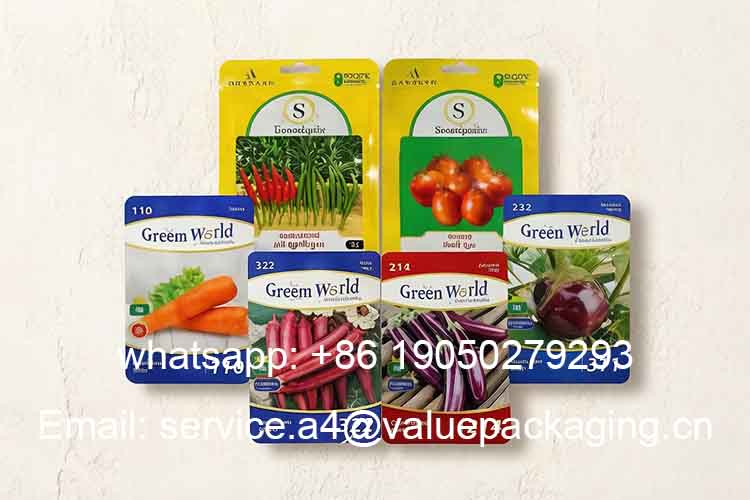
Vegetable seeds are widely used in home gardening, commercial farming, and agricultural distribution. Unlike food products, seeds are living biological materials whose quality is directly linked to germination rate and vitality. Although they are relatively stable when dry, seeds are highly sensitive to moisture, temperature, and environmental conditions. As a result, seed packaging plays a critical role in preserving viability, preventing contamination, and ensuring consistent planting performance over time. At the same time, brands are increasingly exploring eco friendly seed packaging to meet sustainability expectations.
1. Common Vegetable Seed Packaging Solutions
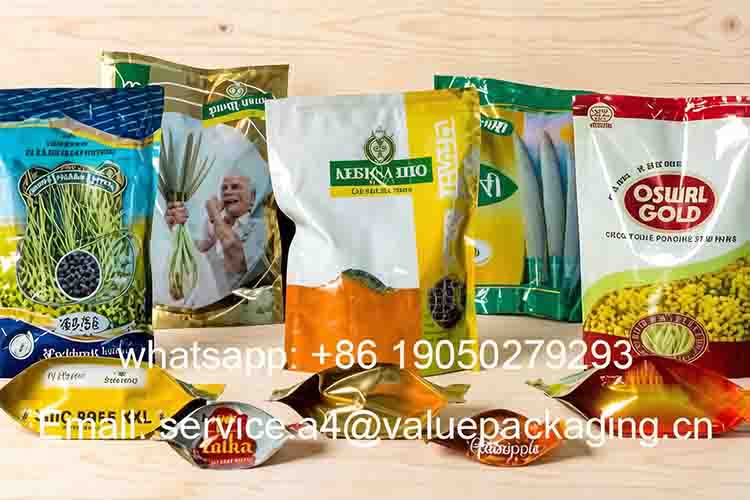
Vegetable seed packaging needs to balance moisture protection, light resistance, and cost efficiency, while supporting both small retail packs and bulk agricultural use.
Paper seed packets
Paper envelopes are one of the most traditional and widely used formats for vegetable seeds. They are lightweight, low cost, and easy to print with planting information. However, paper alone provides very limited moisture protection, so it is mainly used for short shelf life products or combined with inner liners.
Stand up pouches with resealable zippers
These seed pouches are increasingly used for premium or larger volume products. The resealable zipper helps reduce moisture exposure after opening, which is important for maintaining seed quality during repeated use. A hang hole design can also be added for retail display.
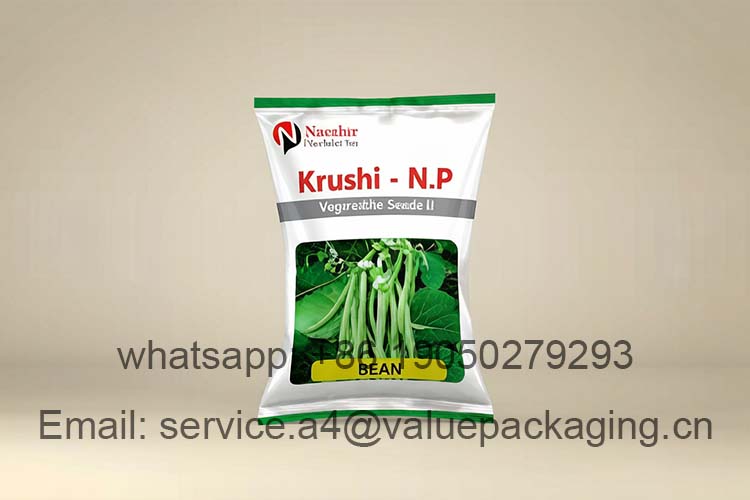
Pillow bags
Pillow bags are a simple and cost effective packaging format for seeds, especially for medium to large volume distribution. They are suitable for automated packing lines and provide reliable sealing for controlled environments.
Small sachets
Small sachets are widely used for single variety, small quantity seed packaging, especially in retail and promotional applications. They are typically designed for one time use, offering good sealing performance and low material cost. This format is convenient for distribution, easy to carry, and suitable for home gardening users.
Foil or high barrier sachets
For high value seeds or long term storage, high barrier sachets are commonly used. These packs offer strong protection against moisture, oxygen, and light, helping maintain germination rates over extended periods, especially in export or professional agricultural markets.
Woven bags for large-volume seeds
Woven bags are commonly used for large-capacity seed packaging in agricultural and wholesale distribution. They offer high mechanical strength and durability, making them suitable for transportation and bulk storage. In many cases, an inner liner is added to improve moisture protection and maintain seed quality during extended handling and storage.
2. Key Packaging Requirements for Vegetable Seeds
Although seeds appear dry and stable, their biological nature means packaging must carefully control environmental conditions.
- Moisture control
Moisture is the most critical factor. Exposure to humidity can trigger premature metabolic activity or mold growth, significantly reducing germination rates. A stable moisture barrier is essential. - Oxygen control
Seeds slowly respire over time. Excess oxygen exposure can accelerate aging and reduce vigor, especially during long storage periods. - Light protection
Some seeds are sensitive to light, which can affect their internal activity over time. Opaque or light resistant packaging helps maintain stability. - Temperature stability support
While packaging cannot fully control temperature, it should help buffer external environmental changes and maintain a stable internal condition.
To meet these requirements, seed packaging materials typically focus on moisture barrier performance first, followed by oxygen and light protection depending on product type and shelf life.
Common materials include:
Compared with food packaging, vegetable seeds generally do not require extreme grease resistance or ultra high oxygen barriers. However, moisture protection is significantly more important due to its direct impact on germination performance.
3. Sustainability Challenges in Conventional Seed Packaging
| Pack Size / Seed Type | Key Focus | Typical Applications |
|---|---|---|
| Small Packs (1g – 50g) | Cost efficiency and basic moisture protection | Retail seed packets, home gardening seeds, high-volume small packs |
| Medium Packs (50g – 500g) | Improved moisture stability for longer storage | Semi-professional growers, bulk retail seeds |
| Large Packs (500g+) | Mechanical strength and consistent moisture control | Agricultural distribution, wholesale seed packaging |
Selecting the right packaging material for vegetable seeds depends not only on barrier requirements, but also on seed characteristics and pack size. In practice, moisture sensitivity, storage duration, and product value determine the level of protection needed, while pack weight influences structure selection and cost control.
Small Pack Sizes (1g – 50g)
This is the most common format for vegetable seeds, especially in retail and home gardening markets. These products typically have relatively fast turnover and are often sold in large volumes.
BOPP / CPP
Kraft Paper / PE
Coated Paper (PE-coated paper)
These structures are widely used due to their cost efficiency and sufficient moisture protection. For most vegetable seeds in small packs, basic barrier performance is adequate, as long as storage conditions are relatively controlled. Coated paper is particularly common in this segment, as it combines the natural appearance of paper with a thin moisture-resistant layer, making it suitable for retail display and branding.
Medium Pack Sizes (50g – 500g) and Large Pack Sizes (500g and above)
This range is commonly used for semi-professional growers, bulk retail, and agricultural distribution, where storage time may be longer and environmental conditions less stable. As pack size increases, packaging needs to balance moisture protection, mechanical strength, and cost efficiency.
PET / PE
BOPP / PE
PET / VMPET / PE
These structures are widely used across both medium and large formats. For medium pack sizes, the focus is mainly on improving moisture stability during extended storage, especially in less controlled environments. As pack size increases further, packaging places greater emphasis on mechanical strength and durability to withstand transportation and bulk handling.
Metallized structures such as PET / VMPET / PE are often introduced when additional moisture and oxygen protection is required, particularly in humid regions or for products with longer shelf life expectations. However, due to cost considerations, they are typically used selectively rather than as a standard solution.
4. Recyclable Mono Material Seed Packaging
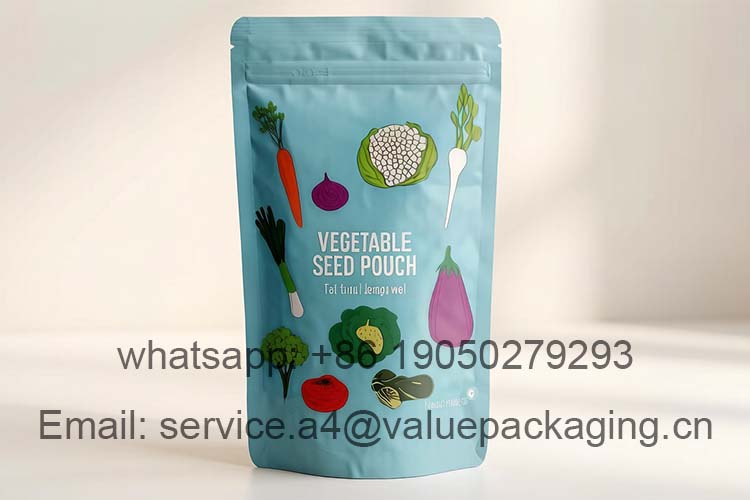
Under growing sustainability demand, mono material packaging is becoming an important direction for vegetable seeds.
PE based solutions typically include:
These materials provide good flexibility and sealing performance. For seeds, they offer reliable moisture protection and package integrity during storage and transport. EVOH layers can be added when additional oxygen barrier is required.
PP based solutions include:
These materials are often selected for their stiffness and good printability, making them suitable for small sachets and high speed production.
Examples of recyclable mono material structures:
- BOPP/VMCPP
- MDOPE/LDPE
- BOPE/LDPE
- MDOPE/BOPE/LDPE
- BOPP/VMCPP
- ABOPP/VMCPP
These structures are designed to improve recyclability while maintaining sufficient moisture protection. Although they do not provide the same barrier level as aluminum based laminates, they are generally adequate for most vegetable seeds, especially for short to medium shelf life.
5. Compostable Seed Packaging
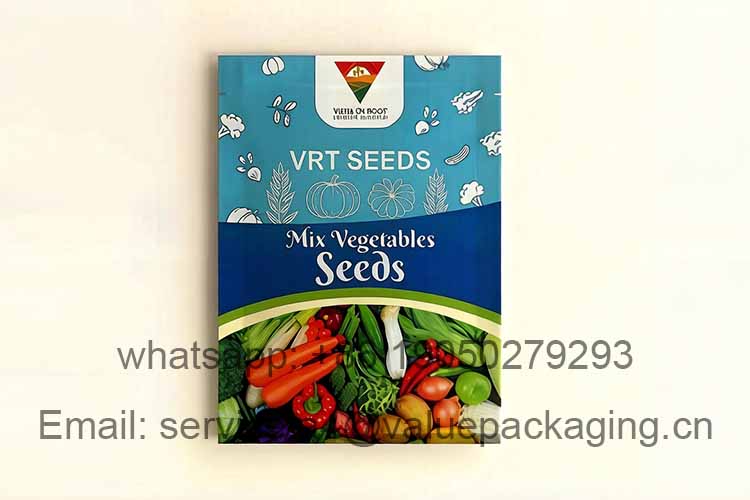
Another emerging direction is compostable packaging made from renewable materials such as PLA, PBAT, and cellulose.
Common compostable materials include:
In practical applications, these materials are usually laminated to improve strength and sealing performance.
Typical compostable structures include:
- Kraft Paper/PLA+PBAT Membrane
- Cellulose/PLA+PBAT Membrane
- Metallized Paper/PLA+PBAT Membrane
- Cellulose/Metallized Cellulose/PLA+PBAT Membrane
- Kraft Paper/Metallized Cellulose/PLA+PBAT Membrane
Compared with conventional plastics, compostable materials generally have lower moisture barrier performance. This is a key limitation for vegetable seeds, as moisture sensitivity is critical. Therefore, these solutions are more suitable for short shelf life products or controlled storage environments.
To improve performance, coated or metallized compostable layers are often used to reduce moisture transmission.
Barrier Properties of Compostable Laminates
| Biodegradable Foil Laminate | WVTR(g/m2/24hr) | OTR (cc/m2/24hr) |
| Cellulose20/Metallized Cellulose20/PLA+PBAT60 | 18 | 2.1 |
| Cellulose20/Metallized Cellulose20/BOPLA40 | 19 | 2.2 |
| K-Cellulose22/Metallized Cellulose20/PLA+PBAT60 | 8 | 0.5 |
| Metallized Paper 69g/Cellulose30/PLA+PBAT60 | 5.6 | 1.12 |
| Cellulose30/Metallized Paper69g/PLA+PBAT60 | 8.9 | 1.1 |
6. Conclusion
Vegetable seed packaging is less about product protection in the traditional sense and more about maintaining a stable, low moisture environment to preserve germination potential.
Effective packaging must control humidity, limit oxygen exposure, and provide sufficient light protection. At the same time, sustainability is becoming an important factor, driving the development of recyclable mono material and compostable solutions.
By selecting the right materials based on storage conditions, shelf life, and market positioning, brands can achieve a balance between performance, cost efficiency, and environmental responsibility while ensuring consistent seed quality.