
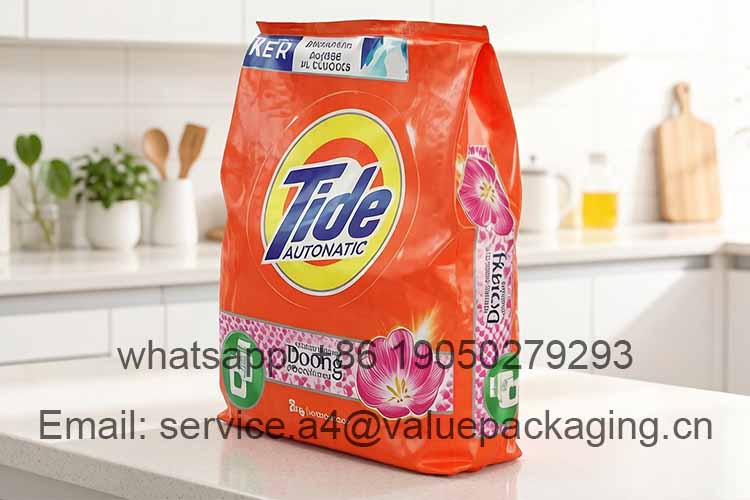
Laundry detergent powder packaging is primarily designed to prevent moisture absorption and ensure structural reliability during storage and transportation. As a hygroscopic and relatively heavy product, detergent powder is highly sensitive to humidity and can easily clump if exposed to moisture, making stable moisture protection essential. At the same time, packaging must withstand compression, stacking, and repeated handling throughout the distribution process, while maintaining seal integrity even in the presence of fine powder. In practical applications, packaging also needs to support efficient high-speed filling and remain cost-effective for large-volume production, making material selection a balance between moisture resistance, strength, and production efficiency.
1. Common Packaging Formats
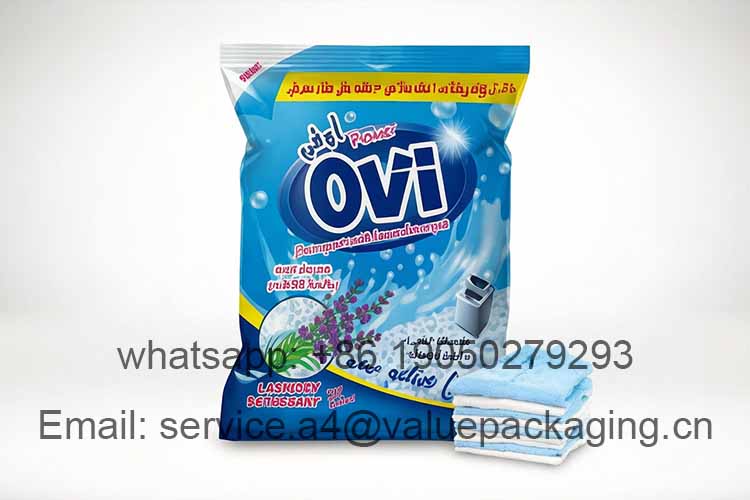
Different packaging formats serve different market needs, from retail display to bulk distribution. Selecting the right format can directly impact product positioning and user experience.
Back seal bags (pillow bags)
Back seal bags, also known as pillow bags, are the most widely used format for small to medium detergent powder packs. The longitudinal seal runs along the back of the package, allowing efficient forming and sealing on high-speed filling lines. This structure offers excellent cost efficiency and is ideal for mass-market products with large production volumes.
Spouted stand-up pouches
Spouted stand-up pouches are used in some detergent powder applications. The integrated spout allows more controlled dispensing, helping reduce powder spillage and improve dosing accuracy during use. The stand-up structure provides good shelf stability, while the resealable cap supports repeated opening and closing. Due to the higher material and production cost, this format is typically positioned for differentiated or higher-value detergent powder products rather than large-scale standard packaging.
Side gusset bags
Side gusset bags feature expandable side panels that increase filling capacity without significantly increasing footprint. This structure improves stacking performance and is suitable for medium to large pack sizes, especially for bulk retail and transportation.
Flat bottom bags (quad seal bags)
Flat bottom bags, also known as quad seal bags, provide a more rigid structure with reinforced side seals. They offer better load-bearing capacity and improved shelf stability compared with standard pouches. This format is commonly used for larger or more premium detergent products where both durability and presentation are important.
Sachet packaging
Sachet packaging is designed for single-use portions or promotional distribution. It is lightweight and cost-effective, making it suitable for sampling and short-term applications, although it is not intended for repeated use.
2. Key Requirements for Detergent Powder Packaging
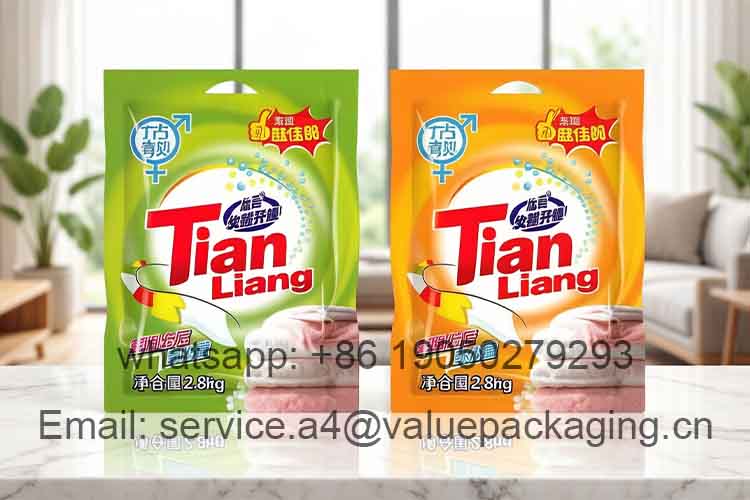
Due to its hygroscopic nature and relatively large pack size, laundry detergent powder places greater demands on packaging compared with many dry consumer products. In practical applications, packaging must not only prevent moisture absorption, but also ensure reliable sealing and sufficient strength to handle filling, transportation, and storage conditions.
Moisture protection
Moisture is the most critical factor in detergent powder packaging. Due to its hygroscopic nature, detergent powder can easily absorb humidity, leading to clumping and reduced flowability. Packaging must provide stable moisture resistance, especially under varying storage and transportation conditions.
Seal integrity
Fine powder can enter sealing areas during filling, affecting seal strength and increasing the risk of leakage. Packaging must maintain reliable sealing performance, even under high-speed production, to ensure product integrity throughout distribution.
Mechanical strength
Detergent packs are often heavy and subject to stacking and handling. Materials must provide sufficient strength and puncture resistance to prevent tearing or bursting, particularly for larger pack sizes.
Chemical compatibility
Detergent formulations may contain alkaline components and active agents. Inner layers must offer good chemical resistance to ensure stable performance and prevent material degradation over time.
Based on these requirements, the choice of packaging materials tends to focus on what is necessary rather than excessive protection. In most cases, maintaining stable moisture resistance, reliable sealing, and sufficient strength is more important than pursuing high barrier performance. This also makes cost-efficient and easy-to-process materials more widely used in detergent powder packaging.
Common materials include:
In detergent powder packaging, milky white PE is more commonly used than transparent PE in practical applications. This is mainly because milky PE provides better light shielding and a more stable visual appearance, helping to reduce the impact of light exposure on the product and maintain a consistent look even when the powder inside is uneven or contains particles of different colors. In addition, milky PE can better conceal powder residue and dust inside the package, which helps improve overall shelf presentation. Compared with transparent PE, it is also less likely to show scratches, deformation, or contamination during transportation and handling, making it a more practical choice for large-volume and high-turnover detergent products.
3. Multi-Layer Laminated Structures in Detergent Powder Packaging
| Pack Size Category | Typical Weight Range | Key Focus |
|---|---|---|
| Small Packs | 50g – 500g | Cost efficiency, high-speed filling, basic moisture protection |
| Medium Packs | 500g – 3kg | Moisture stability, seal reliability, handling durability |
| Large Packs | 3kg – 10kg+ | Mechanical strength, load-bearing capacity, transport stability |
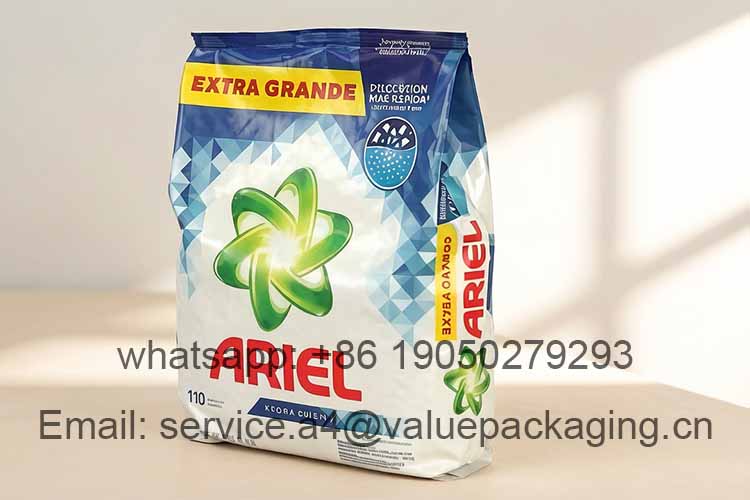
In practical detergent powder packaging, multi-layer laminated films are widely used to enhance overall performance by combining the strengths of different materials. Compared with single-layer films, laminated structures provide better mechanical strength, sealing reliability, and more stable moisture protection, especially for medium to large pack sizes.
PET / White PE
This is one of the most commonly used structures in detergent powder packaging. PET serves as the outer layer, providing good stiffness, printability, and dimensional stability, while white PE acts as the inner layer, ensuring reliable sealing performance and moisture resistance. The white PE layer also helps reduce transparency, improving visual consistency by masking internal powder irregularities, making this structure well suited for retail applications.
PA / White PE
This structure focuses more on flexibility and impact resistance. Compared with PET-based laminates, PA provides better toughness and resistance to tearing under stress, while white PE ensures stable sealing and moisture protection. It is commonly used for medium to large pack sizes where packaging needs to withstand more demanding handling and transportation conditions.
PET / PA / White PE
This structure combines the advantages of both PET and PA. PET provides stiffness and a high-quality printing surface, while PA enhances puncture resistance and overall toughness. The inner white PE layer ensures sealing reliability and moisture resistance. This combination is typically used for larger pack sizes or applications requiring higher mechanical strength and durability during distribution.
These laminated structures are selected based on pack size, distribution conditions, and product positioning, helping achieve a balance between strength, sealing performance, and cost efficiency in real market applications.
4. Recyclable Mono Material Laundry Detergent Powder Packaging
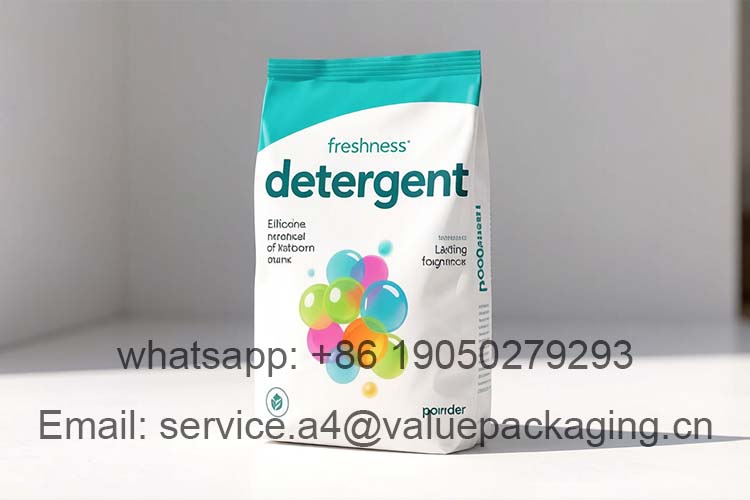
Under increasing sustainability requirements, mono material solutions are gradually being explored in laundry detergent powder packaging. By keeping the structure within a single polymer family, these solutions are more compatible with existing recycling streams and help simplify material recovery compared with traditional laminated structures.
PE-based solutions for detergent powder typically include:
Polyethylene structures are widely used due to their flexibility and stable sealing performance. For detergent powder, they provide basic moisture resistance and help reduce the risk of leakage of fine particles during filling and transportation. At the same time, PE materials perform well on form-fill-seal lines, making them suitable for high-volume production.
Examples of recyclable mono material structures:
- MDOPE/LDPE
- BOPE/LDPE
- MDOPE/BOPE/LDPE
These structures are designed to balance recyclability with practical performance. For detergent powder, the key is to ensure sufficient moisture resistance and consistent sealing, rather than pursuing very high barrier levels. In most applications, these mono-material solutions are more suitable for small to medium pack sizes or products with relatively fast turnover.
5. Compostable Laundry Detergent Powder Packaging
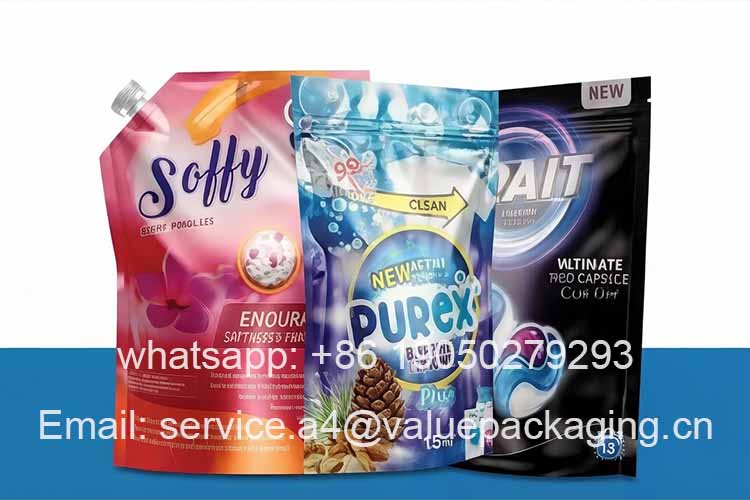
Another developing direction in detergent powder packaging is the use of compostable materials derived from renewable resources such as PLA, PBAT, and cellulose. These materials are designed for industrial composting environments and are mainly used in applications with strong sustainability positioning.
Common compostable materials include:
In practical applications, these materials are typically laminated to improve strength and sealing performance. For detergent powder, packaging must focus on controlling moisture ingress and maintaining structural integrity, especially considering the relatively high pack weight and stacking conditions during transportation.
Typical compostable structures include:
- Cellulose/PLA+PBAT Membrane
- Metallized Paper/PLA+PBAT Membrane
- Cellulose/Metallized Cellulose/PLA+PBAT Membrane
Compared with conventional plastic laminates, compostable materials generally provide lower and less stable moisture resistance, especially under high humidity conditions. In addition, sealing performance and durability under load are more difficult to control in large pack sizes.
As a result, compostable packaging is currently more suitable for small packs, short distribution cycles, or applications where environmental positioning is prioritized over long-term performance.
6. Conclusion
Laundry detergent powder packaging focuses primarily on moisture control, sealing reliability, and mechanical strength to ensure product stability during storage and transportation.
While recyclable mono material solutions are gradually being adopted, their application still needs to balance performance and processability. Compostable materials, although promising from a sustainability perspective, remain limited by moisture resistance and structural performance.
In practical applications, packaging selection is still largely determined by pack size, distribution conditions, and cost considerations, with sustainability solutions being introduced progressively where feasible.