
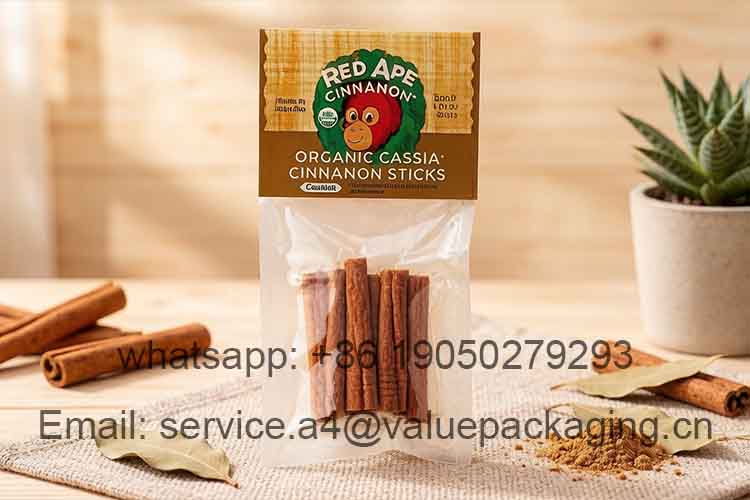
Cinnamon stick packaging plays a critical role in preserving aroma, preventing moisture absorption, and maintaining product quality throughout storage and distribution. As a natural spice rich in volatile oils, cinnamon is sensitive to air exposure and humidity, which can gradually reduce its fragrance and overall quality.
For brands and suppliers, the challenge is not only to protect the product, but also to deliver packaging that supports shelf appeal, usability, and cost efficiency. Well-designed flexible packaging helps maintain product freshness while enhancing presentation and meeting evolving sustainability expectations.
1. Flexible Packaging Formats for Cinnamon Sticks
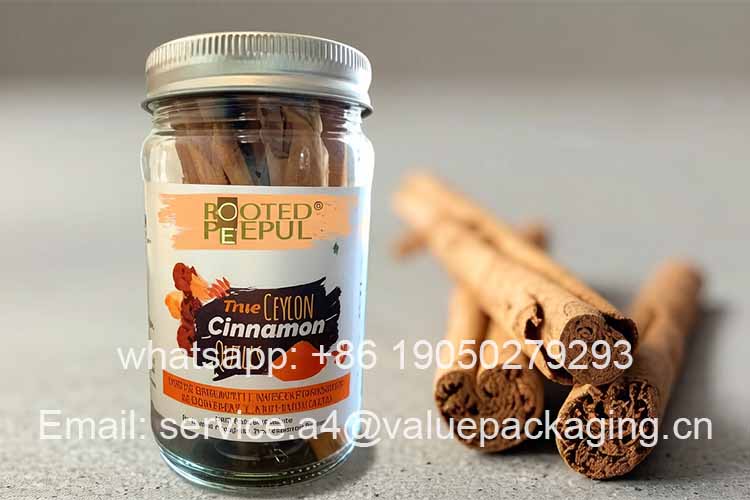
Different packaging formats serve different market needs, from retail display to bulk distribution. Selecting the right format can directly impact product positioning and user experience.
Stand-up pouches with zipper
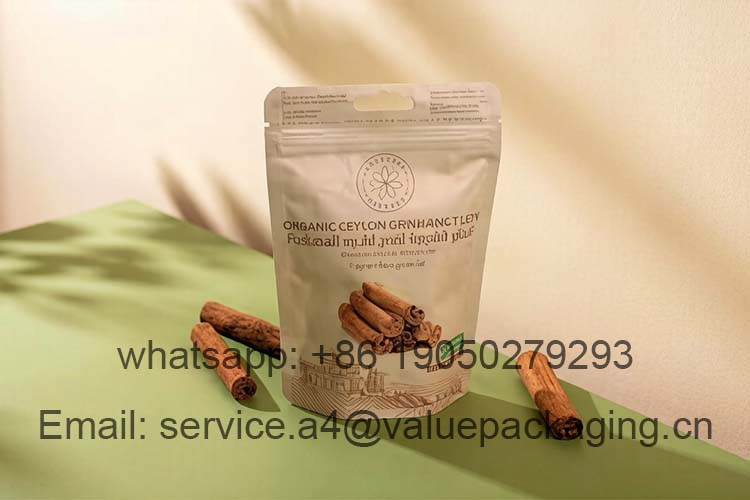
Stand-up pouches are widely used in retail environments due to their strong shelf presence and large printable area. The addition of a resealable zipper allows consumers to repeatedly open and close the package while maintaining freshness, making it suitable for household use.
A transparent window can also be incorporated into the pouch design, allowing consumers to directly view the cinnamon sticks inside, which helps enhance product visibility and build trust in product quality.
Flat bottom pouches
Flat pouches offer a more economical solution, especially for bulk packaging or price-sensitive markets. They are efficient for production and transportation, making them a practical choice for large-volume distribution.
Window pouches
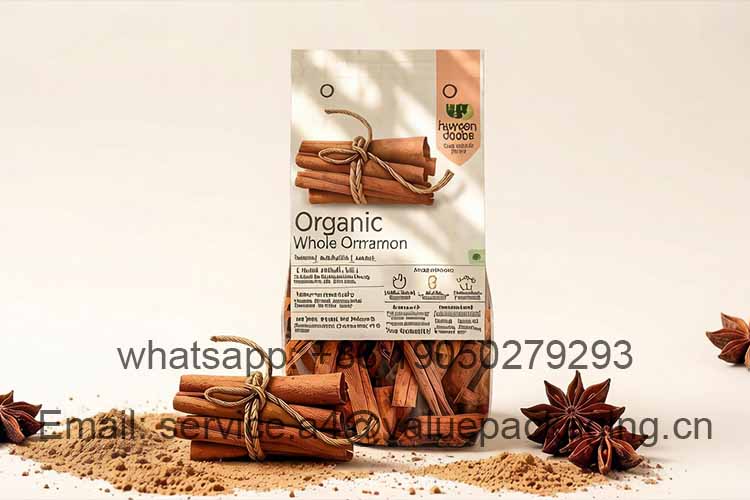
Packaging with transparent windows allows consumers to directly see the cinnamon sticks inside, reinforcing product authenticity and quality perception. This format is often used in premium or natural product lines.
Sachet packaging
Sachets are designed for single-use portions or food service applications. They provide convenience and portion control, although they are typically not resealable.
Bottle packaging
Bottle packaging is often used for retail-ready or premium cinnamon stick products. Rigid containers such as plastic or glass bottles provide strong protection against breakage and external pressure. They also offer convenient resealing and enhance product visibility, especially when clear packaging is used.
2. Key Requirements for Cinnamon Stick Packaging
Although cinnamon sticks are a dry product, their packaging must address several important performance factors to ensure consistent quality.
- Moisture protection
Cinnamon sticks can absorb moisture from the surrounding environment, which may lead to softening, mold risk, or quality degradation. Reliable moisture barrier performance is essential. - Aroma retention
The value of cinnamon largely comes from its natural aroma. Packaging must limit the loss of volatile compounds to preserve fragrance over time, especially for longer shelf-life products. - Oxygen control
While cinnamon is not highly oxygen-sensitive, prolonged exposure can gradually reduce flavor intensity. A moderate oxygen barrier helps maintain product quality. - Seal integrity
Consistent and reliable sealing is necessary to prevent contamination and maintain internal conditions during storage and transport. - Mechanical protection
Cinnamon sticks are relatively rigid but can break under pressure. Packaging structures should provide sufficient strength to reduce breakage during handling and logistics.
To meet these requirements, cinnamon stick packaging materials typically focus on moisture barrier and aroma retention first, followed by oxygen and light protection depending on product positioning and shelf life.
Common materials include:
- PET film
- VMPET film
- LDPE film
- BOPP film
- Kraft paper
3. Material Selection and Structure Design
Selecting the right packaging material is essential for preserving cinnamon stick quality and aroma. Different materials provide varying levels of moisture barrier, aroma retention, and mechanical protection, making them suitable for different market segments.
Depending on the usage scenario and shelf-life requirements, cinnamon stick packaging can be divided into the following categories:
| Application Type | Key Features | Suitable Shelf Life |
|---|---|---|
| Foodservice and Short-Term Use | High transparency and visual appeal; basic moisture protection; limited aroma barrier | Short-term use, e.g., foodservice, freshly packed spices, fast turnover products |
| Short Shelf Life | Cost-effective with basic moisture protection; suitable for high-volume production | Fast-moving retail products; short distribution cycles |
| Medium Shelf Life | Improved moisture barrier and aroma retention; better mechanical strength | Standard retail products requiring stable quality during storage and transport |
| Long Shelf Life | Enhanced moisture and aroma barrier; suitable for extended storage or export | Export markets or products with longer distribution cycles |
Short Shelf Life Applications
BOPP / LDPE
This structure is widely used for cost-sensitive, high-volume products. It provides basic moisture protection and reliable sealing performance, which is sufficient for short distribution cycles and controlled storage conditions. Due to its good clarity and processability, it is often applied in simple retail packaging where product turnover is relatively fast and extended aroma retention is not a primary concern.
Kraft Paper / PE
This structure combines a natural appearance with functional protection. The outer kraft paper layer enhances shelf appeal, making it suitable for organic or premium-positioned products, while the inner PE layer provides essential moisture resistance and sealing performance. It is typically used in short shelf-life applications where branding and visual differentiation are important, and storage conditions are relatively stable.
Medium Shelf Life Applications
PET / LDPE
Compared with BOPP-based laminates, this structure offers improved mechanical strength and dimensional stability, making it more suitable for products that require better durability during transportation and handling. It provides consistent moisture protection and is commonly used for standard retail products with moderate shelf life expectations.
BOPP (Matte) / VMPET / PE
The addition of a metallized layer significantly enhances moisture barrier performance and helps reduce the loss of volatile aromatic compounds. This structure provides a balanced solution between cost and performance, making it suitable for products that require improved aroma retention and more stable quality over time, especially in less controlled storage environments.
Long Shelf Life Applications
PET / VMPET / PE
This is one of the most widely used high-performance structures for cinnamon stick packaging. The combination of PET and VMPET delivers strong moisture barrier and improved aroma retention, helping to maintain product quality during extended storage. It is particularly suitable for export markets, humid environments, or products with longer distribution cycles. In addition to barrier performance, the PET outer layer also provides enhanced strength and printability, supporting both protection and brand presentation.
4. Recyclable Mono Material Cinnamon Stick Packaging
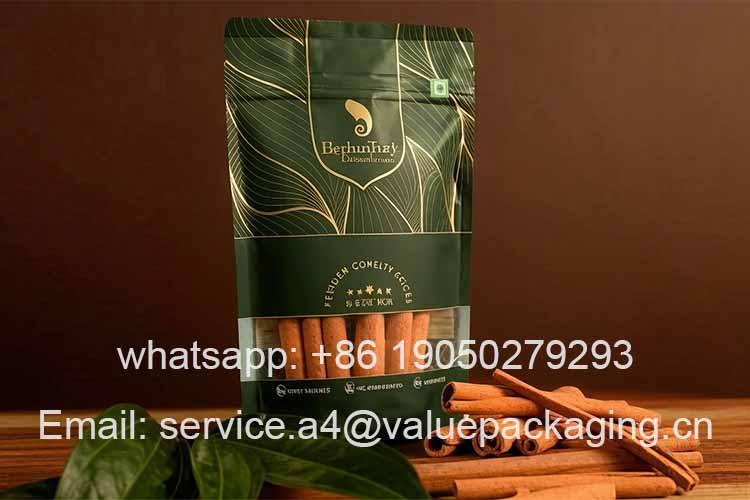
Under increasing sustainability requirements, mono material solutions are becoming a practical direction for cinnamon stick packaging. By keeping the structure within a single polymer family, these pouches are more compatible with existing recycling systems and help reduce the complexity associated with traditional multi-material laminates.
PE-based solutions for cinnamon sticks typically include:
Polyethylene structures are widely used due to their flexibility and reliable sealing performance. For cinnamon sticks, they provide stable moisture protection and help maintain package integrity during transportation and handling. Since cinnamon sticks are sensitive to humidity, PE-based materials are effective in keeping the product dry under normal storage conditions. When combined with EVOH, the structure can also offer moderate oxygen barrier, helping reduce the loss of volatile aromatic compounds over time.
PP-based solutions commonly include:
Polypropylene materials are valued for their stiffness, clarity, and clean appearance, making them suitable for retail packaging with strong shelf presentation. They also perform well on high-speed packaging lines, especially for formats such as pillow bags or small retail packs. Metallized PP films can further improve moisture barrier and support better aroma retention without significantly increasing material complexity.
Examples of recyclable mono material structures:
- MDOPE/LDPE
- BOPE/LDPE
- MDOPE/BOPE/LDPE
- BOPP/VMCPP
- ABOPP/VMCPP
These structures are designed to balance functionality with recyclability. While they do not provide the same level of barrier performance as aluminum-based laminates, they offer sufficient protection for cinnamon sticks, where maintaining dryness and preserving natural aroma are the primary concerns. At the same time, they support a more sustainable packaging approach aligned with current market trends.
5. Compostable Cinnamon Stick Packaging
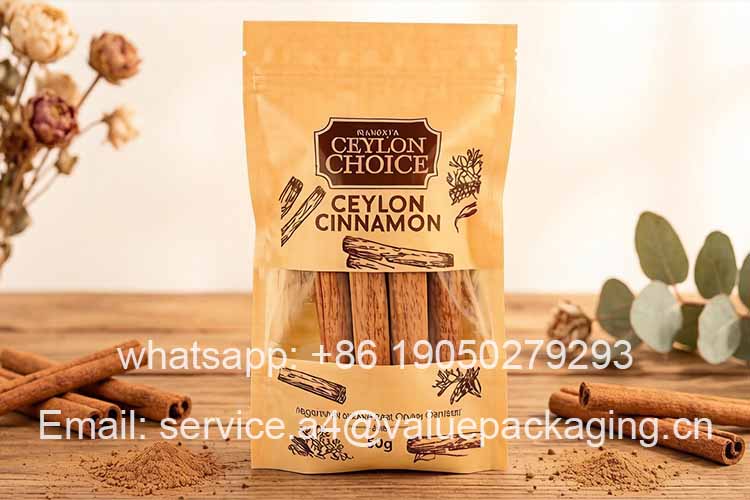
Another developing direction in cinnamon stick packaging is the use of compostable materials derived from renewable resources such as PLA, PBAT, and cellulose. These materials are designed to break down under industrial composting conditions, providing an alternative to conventional plastics for brands focused on sustainability.
Common compostable materials include:
In practical applications, these materials are rarely used as single layers. They are typically laminated to improve mechanical strength, sealing reliability, and overall usability. For cinnamon sticks, packaging must focus on limiting moisture ingress and reducing aroma loss, especially in environments with fluctuating humidity.
Typical compostable structures include:
- Kraft Paper/PLA+PBAT Membrane
- Cellulose/PLA+PBAT Membrane
- Metallized Paper/PLA+PBAT Membrane
- Cellulose/Metallized Cellulose/PLA+PBAT Membrane
Compared with products containing oil or grease, cinnamon sticks place greater emphasis on moisture control and aroma preservation. Compostable materials can meet basic requirements in these areas, but their barrier performance is generally lower than that of conventional laminates. To improve functionality, metallized or coated compostable layers are often introduced to help reduce moisture and oxygen transmission.
As a result, compostable packaging is more suitable for short to medium shelf life applications or products distributed under relatively controlled conditions.
Barrier Properties of Compostable Laminates
| Biodegradable Foil Laminate | WVTR(g/m2/24hr) | OTR (cc/m2/24hr) |
| Cellulose20/Metallized Cellulose20/PLA+PBAT60 | 18 | 2.1 |
| Cellulose20/Metallized Cellulose20/BOPLA40 | 19 | 2.2 |
| K-Cellulose22/Metallized Cellulose20/PLA+PBAT60 | 8 | 0.5 |
| Metallized Paper 69g/Cellulose30/PLA+PBAT60 | 5.6 | 1.12 |
| Cellulose30/Metallized Paper69g/PLA+PBAT60 | 8.9 | 1.1 |
6. Conclusion
Cinnamon stick packaging focuses primarily on maintaining dryness, preserving natural aroma, and protecting product integrity during handling and transport.
With increasing demand for sustainable solutions, recyclable mono material packaging and compostable materials are gaining attention. However, ensuring consistent moisture protection and minimizing aroma loss remain key challenges.
By selecting appropriate materials based on shelf life, distribution conditions, and product positioning, brands can achieve a practical balance between packaging performance and environmental responsibility.