
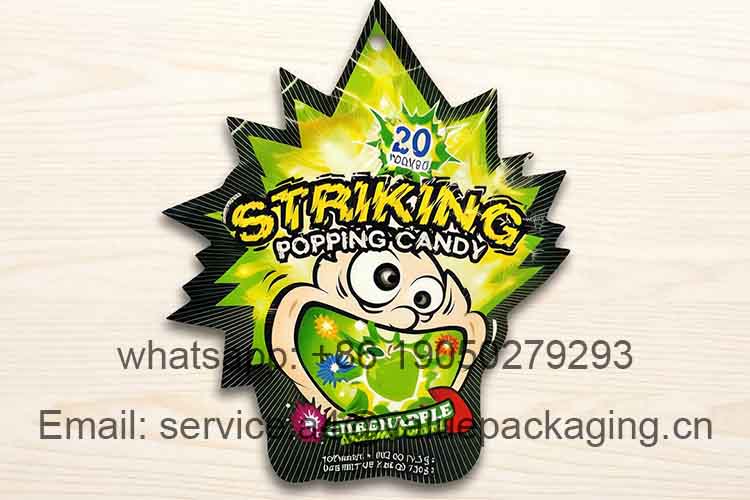
Popping candy is a moisture-sensitive confectionery product that relies on trapped carbon dioxide to create its characteristic popping effect. Once exposed to humidity, the structure breaks down and the popping sensation is significantly reduced or lost. As a result, packaging must provide strong moisture protection, reliable sealing, and consistent barrier performance to maintain product quality throughout storage and distribution, while also supporting high-speed filling, ensuring portion control, and delivering an engaging consumer experience, especially in retail and novelty candy markets.
1. Common Popping Candy Packaging Formats
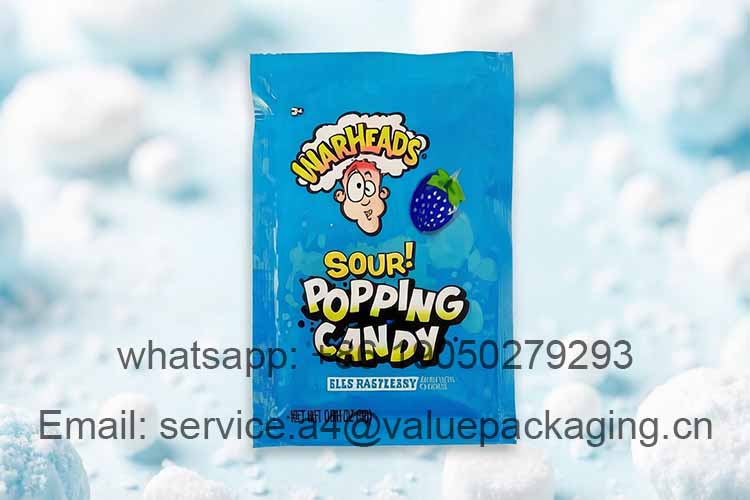
Different packaging formats are selected based on product positioning, portion size, and distribution channels, with a strong focus on moisture protection, portion control, and production efficiency.
Sachet packaging (three-side seal and four-side seal)
Sachets are the most widely used format for popping candy. Common types include three-side seal and four-side seal sachets. Three-side seal structures are more cost-efficient and suitable for high-speed production, while four-side seal sachets provide better shape consistency and a more premium appearance. These formats are ideal for single-use portions, effectively limiting exposure to humidity and helping preserve the popping effect. They are widely used in retail packs, multi-pack cartons, and promotional distribution.
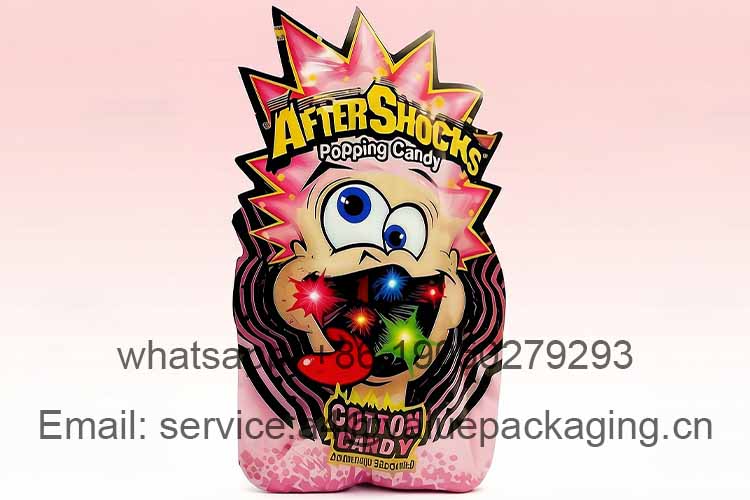
Shaped sachets
For products targeting children or novelty markets, shaped sachets are often used. These customized forms, such as cartoon shapes or irregular outlines, enhance shelf appeal and brand recognition. While maintaining the same functional structure as standard four-side seal sachets, they provide stronger visual differentiation, especially in impulse purchase scenarios.
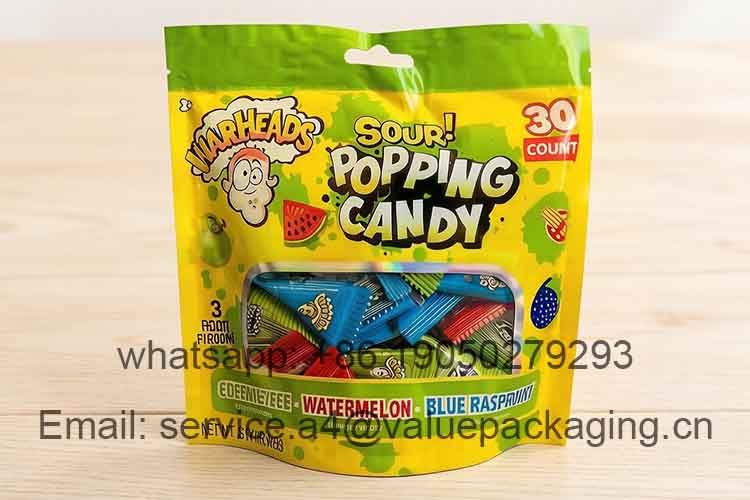
Stand-up pouches (with and without zipper)
Stand-up pouches are used for multi-portion or family-size popping candy products. Versions with zippers allow repeated opening and closing, helping reduce moisture exposure after initial use. Non-zipper stand-up pouches are more cost-effective and typically used for products intended to be consumed quickly after opening. The stand-up structure also provides good shelf stability and a larger printable area for branding.
Pillow bags (back seal bags)
Pillow bags are commonly used for larger-volume or multi-pack applications. The back seal structure supports efficient production on high-speed packaging lines and offers good cost efficiency. However, due to limited resealability, they are typically used in combination with inner sachets or for products with faster turnover.
2. Key Requirements for Popping Candy Packaging
Due to its unique structure and sensitivity to environmental conditions, popping candy places strict demands on packaging materials.
Moisture protection
Moisture is the most critical factor. Even slight exposure to humidity can deactivate the popping effect. Packaging must provide stable and consistent moisture barrier throughout storage and distribution.
Seal integrity
Popping candy is usually packed in small portions, making seal reliability essential. Fine particles may affect sealing during filling, so packaging must ensure consistent and secure seals to prevent moisture ingress.
Oxygen barrier
Although less critical than moisture, oxygen can still affect flavor stability over time. A moderate oxygen barrier helps maintain overall product quality, especially for longer shelf life.
Mechanical protection
Popping candy granules are relatively fragile. Packaging should provide sufficient strength to protect the product from compression or damage during transportation and handling.
Based on these requirements, popping candy packaging places greater emphasis on moisture barrier performance than most confectionery products. In practical applications, multi-layer laminated structures are commonly used to combine barrier protection, sealing reliability, and mechanical strength within a single solution.
Common materials include:
3. Material Selection in Popping Candy Packaging
| Packaging Structure | Moisture Barrier | Oxygen Barrier | Overall Barrier Level | Typical Application |
|---|---|---|---|---|
| PET / LDPE | Low to Medium | Low | Basic | Short shelf life, fast turnover, controlled environments |
| PET / VMPET / LDPE | Medium to High | Medium | Balanced | Mainstream retail popping candy, sachets, multi-pack products |
| PET / AL / LDPE | Very High | Very High | High Barrier | Premium products, humid environments, long distribution cycles |
Packaging structures used for popping candy can vary significantly in barrier performance. Since moisture protection directly affects the product’s popping effect, selecting the right laminate depends not only on shelf life requirements, but also on storage conditions, distribution channels, and cost targets. The following comparison shows how common structures differ in overall protective performance for popping candy packaging.
Typical Structures for Popping Candy Packaging
PET / PE
This is a basic and cost-effective structure. PET provides good mechanical strength and printability, while LDPE ensures reliable sealing. However, its moisture barrier is relatively limited, making it more suitable for products with short shelf life or fast turnover, especially when distribution conditions are relatively controlled.
PET / VMPET / PE
This is one of the most commonly used structures for popping candy. The metallized PET layer significantly improves moisture barrier performance compared with PET / LDPE, helping protect the popping effect under normal storage conditions. At the same time, it offers a good balance between cost, protection, and production efficiency, making it widely used in retail sachets and multi-pack formats.
PET / AL / PE
This structure provides extremely high barrier against moisture, oxygen, and light. From a performance perspective, it offers the strongest protection for popping candy, especially in humid environments or long distribution cycles.
However, in practical applications, aluminum foil is not commonly used for standard popping candy packaging. This is mainly because its barrier performance often exceeds actual needs, while significantly increasing material cost and reducing flexibility in high-speed production. As a result, it is typically reserved for premium products or special conditions where maximum protection is required, rather than mainstream retail applications.
4. Recyclable Mono-Material Popping Candy Packaging
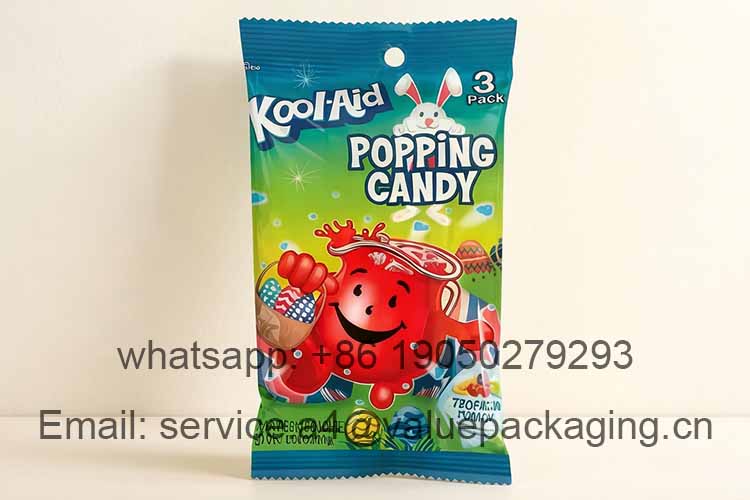
Under growing sustainability pressure, mono material solutions are being explored for popping candy packaging. By keeping the structure within a single polymer family, these pouches are more compatible with existing recycling systems and help reduce the complexity of traditional multi-layer laminates.
PE-based solutions for popping candy typically include:
Polyethylene structures are valued for their flexibility and reliable sealing performance. In popping candy applications, they can provide basic moisture protection and maintain package integrity during transportation and handling. However, due to the high sensitivity of popping candy to humidity, the moisture barrier of mono PE structures is still limited compared with conventional laminated films, making them more dependent on controlled storage and shorter shelf life.
Examples of recyclable mono material structures:
- MDOPE/LDPE
- BOPE/LDPE
- MDOPE/BOPE/LDPE
These structures are designed to balance functionality with recyclability. In practical use, they are mainly suitable for products with fast turnover or relatively controlled distribution conditions. Compared with metallized or aluminum-based laminates, their moisture barrier performance is lower, which remains the main limitation for wider application in popping candy packaging.
5. Compostable Popping Candy Packaging
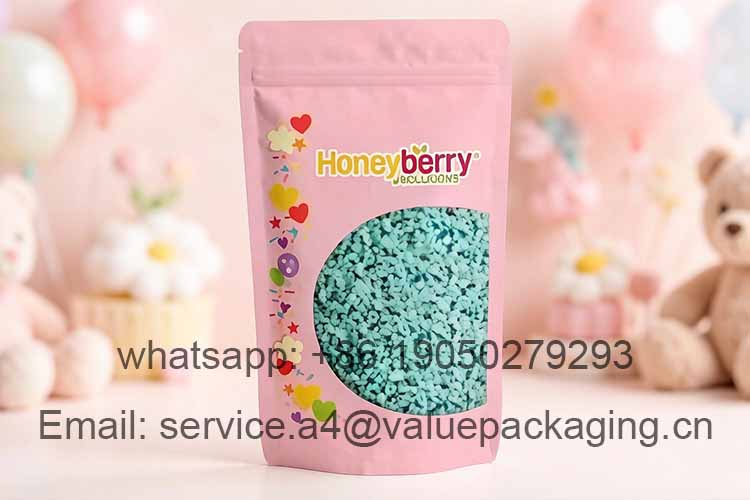
Another emerging direction in popping candy packaging is the use of compostable materials derived from renewable resources such as PLA, PBAT, and cellulose. These materials are designed to break down under industrial composting conditions, offering an alternative to conventional fossil-based plastics, particularly for brands with strong sustainability positioning.
Common compostable materials include:
In practical applications, these materials are rarely used as single layers. They are typically laminated to improve mechanical strength, sealing reliability, and overall usability. For popping candy, packaging must focus primarily on moisture protection, as even slight humidity exposure can deactivate the popping effect.
Typical compostable structures include:
Popping candy is highly sensitive to moisture, which means packaging must provide a high and stable moisture barrier to maintain product performance during storage and distribution.
One of the main limitations of compostable laminates is their relatively lower and less stable moisture barrier compared with conventional metallized or aluminum-based structures. As a result, they are generally more suitable for short shelf life products or applications with controlled storage conditions. To improve performance, metallized compostable layers are often introduced to help reduce moisture transmission, although their overall protection is still limited.
6. Conclusion
Popping candy packaging is fundamentally driven by moisture control, as even minimal humidity exposure can directly affect product performance. In practical applications, multi-layer laminated structures remain the most reliable solution, providing the necessary balance of moisture barrier, seal integrity, and mechanical strength.
While recyclable mono-material and compostable options are gaining attention, their application in popping candy packaging is still limited by relatively lower and less stable moisture barrier performance. As a result, their use is currently more suitable for short shelf life products or controlled distribution conditions.
Overall, selecting the right packaging structure depends on shelf life requirements, distribution environment, and cost considerations. Achieving a balance between effective moisture protection and sustainability remains the key challenge for future development in popping candy packaging.