
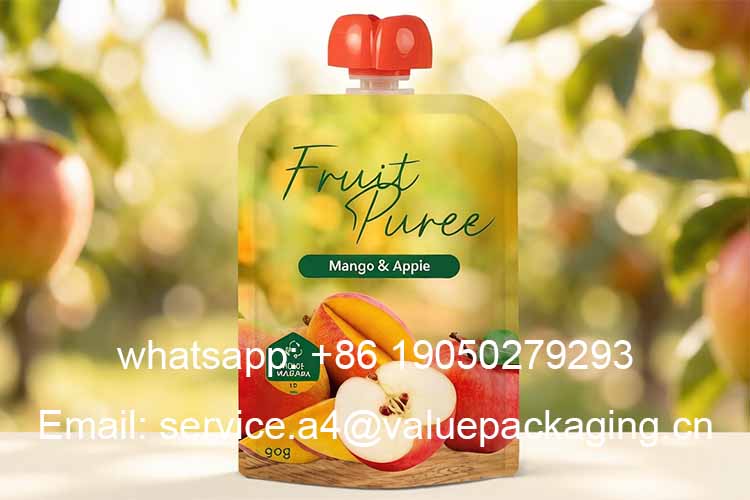
Fruit puree is a semi-liquid product with relatively high moisture content and, in many cases, natural acidity. Depending on formulation and processing methods such as hot filling or retort sterilization, packaging must protect product freshness, maintain seal integrity, and withstand processing and distribution conditions. Because puree products can be sensitive to oxygen exposure, moisture migration, and mechanical stress, packaging also plays an important role in preserving flavor, color, and overall product stability. For products aimed at children or on-the-go consumption, packaging additionally needs to support convenience, portion control, and safe dispensing while maintaining practical performance throughout distribution.
1. Common Fruit Puree Packaging Formats
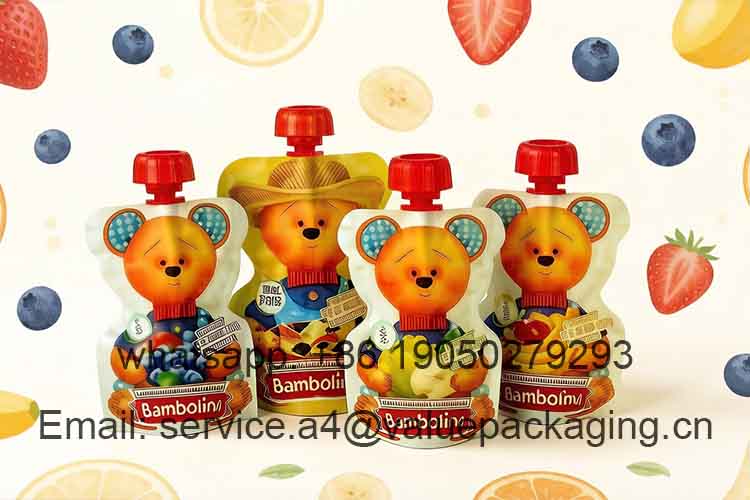
Different packaging formats are selected based on filling process, portion size, and market positioning, with a strong focus on convenience, controlled dispensing, and compatibility with filling conditions.
Spouted stand-up pouches
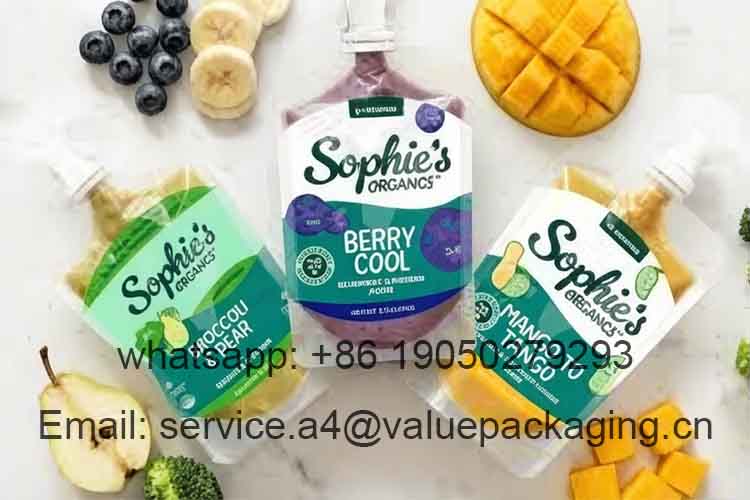
This is one of the most widely used formats for fruit puree packaging, particularly for baby food and snack applications. The spout allows controlled dispensing and convenient consumption, while the stand-up structure provides good shelf stability and a large printable area. The resealable cap also supports repeated use for multi-serve products.
Shaped spouted pouches
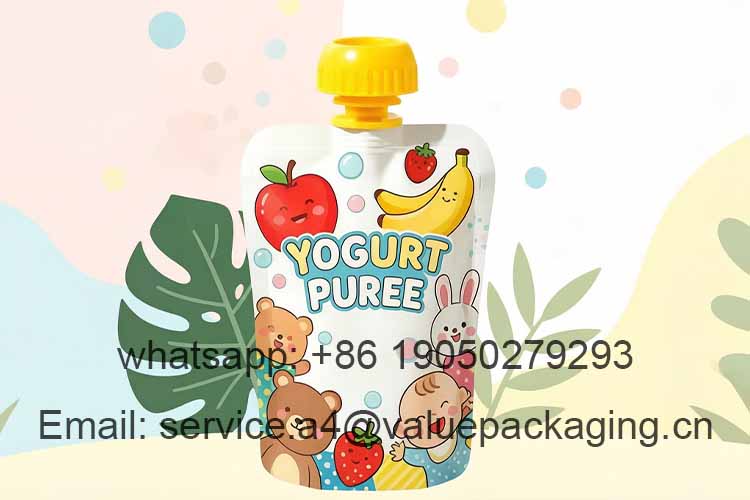
Custom-shaped spouted pouches are often used in children’s products to improve shelf appeal and brand differentiation. While maintaining the same functional structure as standard spouted pouches, they offer stronger visual impact in retail environments.
Three-side seal sachets
Commonly used for small portions or promotional formats, this structure is cost-efficient and suitable for single-serve fruit puree products. It also supports efficient production and portion control.
Pillow bags for stick packs
Used for elongated stick-pack formats intended for direct consumption or portion-controlled applications. This format offers good material efficiency and is commonly used for portable fruit puree snacks.
2. Key Requirements for Fruit Puree Packaging
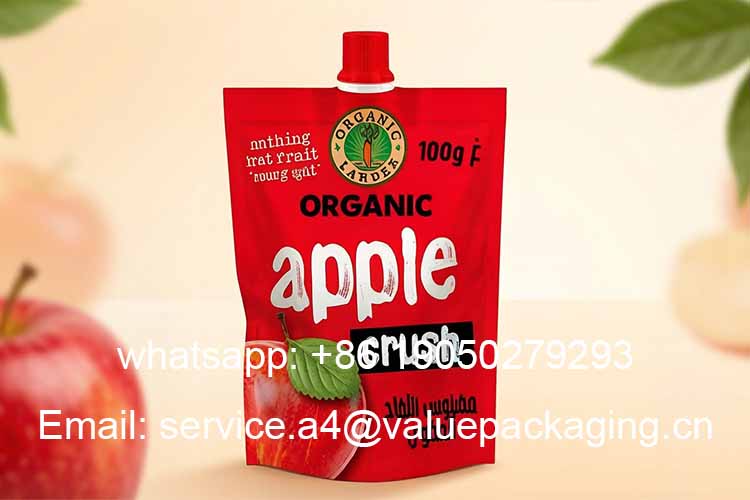
Compared with dry food products, fruit puree places greater demands on packaging materials due to its high moisture content, natural acidity, and possible thermal processing conditions. In practical applications, packaging must balance barrier protection, seal reliability, chemical stability, and mechanical strength.
Barrier protection
Reliable oxygen and moisture barrier helps preserve flavor, color, and nutritional quality, while reducing the risk of oxidation or quality deterioration during storage.
Seal integrity
Strong seals are essential, particularly for spouted pouches and products subjected to hot filling or retort processing. Packaging must maintain seal strength to prevent leakage and ensure product safety.
Chemical compatibility
Because fruit puree is often acidic, inner sealant layers must be compatible with the product and remain stable throughout shelf life.
Mechanical strength
Packaging should provide sufficient puncture resistance and durability to withstand transportation, handling, and the stress placed on spouted structures.
Common materials include:
Retort cast polypropylene(RCPP) is widely used in fruit puree packaging where heat resistance and seal reliability are important. It offers strong sealing performance, good product compatibility, and can withstand high temperature retort processing, making it suitable as an inner sealant layer for thermally processed puree products.
3. Material Selection in Fruit Puree Packaging
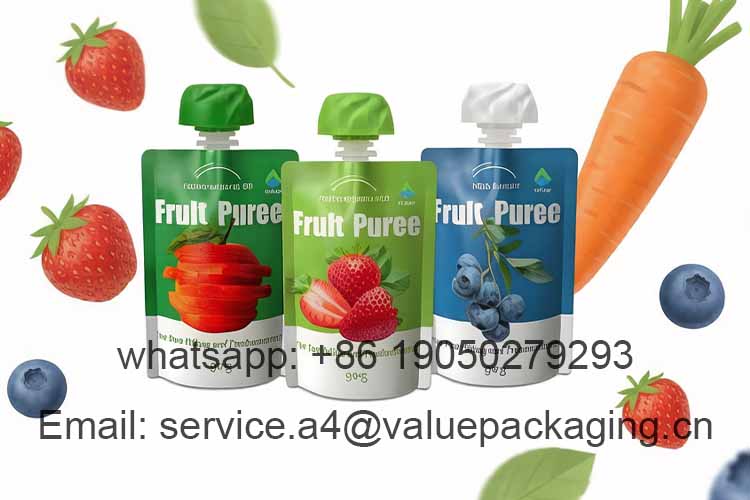
| Main Component | Packaging Consideration | Why It Matters |
|---|---|---|
| Fruit Solids and Pulp | Product compatibility | Pulp particles can affect flowability, filling performance, and package dispensing, especially in spouted pouches |
| Natural Fruit Acids | Chemical resistance | Acidic formulations require compatible inner sealant layers to maintain material stability |
| Water Content | Moisture and oxygen barrier | High moisture products require stable barrier protection to help preserve flavor and product quality |
| Sugars and Natural Nutrients | Oxidation protection | Sensitive ingredients may degrade with oxygen exposure, affecting color, taste, and nutritional value |
| Heat Processed Formulations | Thermal resistance | Hot fill or retort products require packaging that can withstand processing temperatures and maintain seal integrity |
In practical applications, the choice of packaging structure often depends on the balance between product composition, processing conditions, shelf life, and distribution requirements. Different laminate structures provide varying levels of barrier performance, chemical stability, and mechanical strength, making material selection an important part of fruit puree packaging design.
Typical Structures for Fruit Puree Packaging
PET / AL / PE
A widely used structure balancing cost and barrier performance, suitable for standard ambient fruit puree products. The metallized layer improves oxygen and moisture protection compared with basic laminates, helping support longer shelf life while maintaining cost efficiency.
PET / AL / RCPP
This is a high-barrier foil structure often used for retortable or long shelf life fruit puree packaging. Aluminum foil provides excellent oxygen, moisture, and light protection, while RCPP supports heat resistance and sealing performance required for thermal processing.
4. Recyclable Mono Material Fruit Puree Packaging
Under growing sustainability pressure, mono material solutions are increasingly being explored for fruit puree packaging. By keeping the structure within a single polymer family, these pouches are more compatible with existing recycling systems and help reduce the complexity associated with conventional multi-layer laminates.
PE-based solutions for fruit puree typically include:
Polyethylene structures are valued for their flexibility and reliable sealing performance. In fruit puree applications, they can provide good package integrity and basic moisture protection, while EVOH-containing structures can improve oxygen barrier performance, which is important for preserving flavor, color, and product quality.
Examples of recyclable mono material structures include:
- MDOPE/LDPE
- BOPE/LDPE
- MDOPE/BOPE/LDPE
These structures are designed to balance functionality with recyclability. In practical applications, they are mainly suitable for short to medium shelf life fruit puree products or products distributed under relatively controlled conditions. Compared with conventional foil or metallized laminates, barrier performance may still be lower, which remains one of the main limitations for broader adoption, particularly for long shelf life or retort applications.
5. Compostable Fruit Puree Packaging
Another emerging direction in fruit puree packaging is the use of compostable materials derived from renewable resources such as PLA, PBAT, and cellulose. These materials are designed to break down under industrial composting conditions, offering an alternative to conventional fossil-based plastics for sustainability-focused applications.
Common compostable materials include:
In practical applications, these materials are rarely used as single layers. They are typically laminated to improve mechanical strength, sealing reliability, and barrier performance. For fruit puree, packaging must not only help control oxygen and moisture transmission, but also maintain stability under filling and distribution conditions.
Typical compostable structures include:
One of the main limitations of compostable laminates is their generally lower and less stable barrier performance compared with conventional high-barrier structures, particularly for long shelf life or thermally processed products. As a result, they are generally more suitable for short shelf life products or applications with controlled distribution conditions.
6. Conclusion
Fruit puree packaging is driven primarily by barrier protection, seal reliability, and compatibility with filling and processing conditions. In practical applications, conventional laminated structures remain the most widely used solution, providing a balance of product protection, durability, and production efficiency.
While recyclable mono material and compostable options are gaining attention, their application still depends on balancing sustainability with barrier performance and process requirements. For future development, achieving both effective protection and improved environmental performance remains a key focus in fruit puree packaging.