
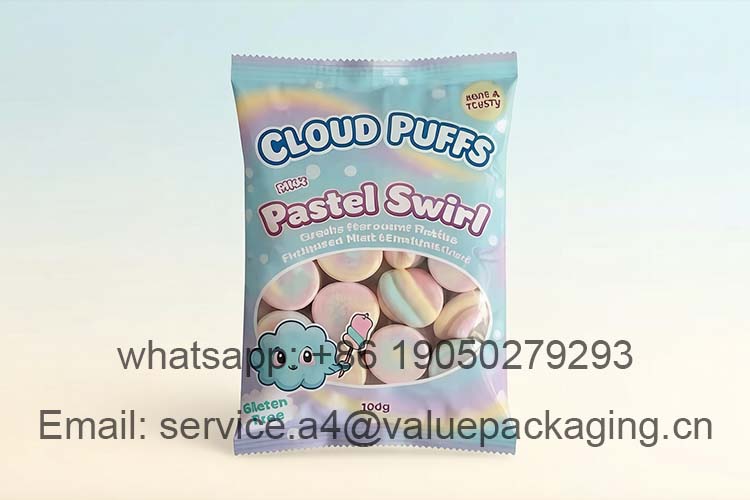
Marshmallows are a soft, aerated confectionery product that is highly sensitive to moisture and compression. Exposure to humidity can lead to stickiness and surface dissolution, while low humidity may cause hardening. At the same time, their light and fluffy structure makes them prone to deformation under pressure. As a result, marshmallow packaging must balance moisture control, sealing reliability, and mechanical protection to maintain texture and appearance throughout storage and distribution. In addition, packaging plays an important role in product presentation, as marshmallows are often sold in visually driven retail environments.
1. Common Marshmallow Packaging Formats
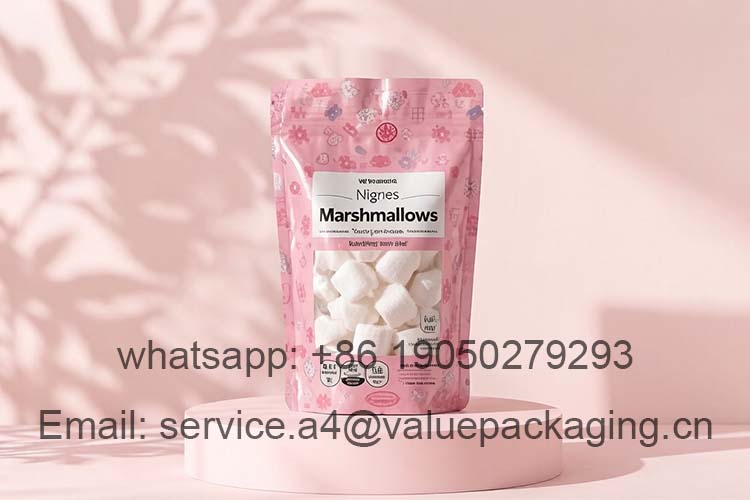
Different packaging formats are used depending on product size, portioning, and market positioning.
Pillow bags (back seal bags)
Pillow bags are the most widely used format for marshmallows, especially in mass retail. The back seal structure supports efficient production on high-speed packaging lines and offers strong cost efficiency. This format is typically used for standard supermarket products with fast turnover. It provides sufficient protection under normal conditions, although it is not resealable, so it is more suitable for single-use or quick consumption scenarios.
Stand-up pouches (with and without zipper)
Stand-up pouches are increasingly used for marshmallows due to their strong shelf presence and larger printable area. Zipper versions allow repeated opening and closing, helping maintain product softness and reduce moisture exchange after opening, making them suitable for household consumption. Non-zipper versions are more cost-effective and are typically used for products intended to be consumed shortly after opening. This format is often used for mid to premium positioning.
Side gusset bags
Side gusset bags are commonly used for medium to large pack sizes. The expandable side panels increase filling capacity without significantly increasing the footprint, making them efficient for bulk retail and transportation. This structure also improves stacking stability, which is important for soft products like marshmallows that can deform under pressure.
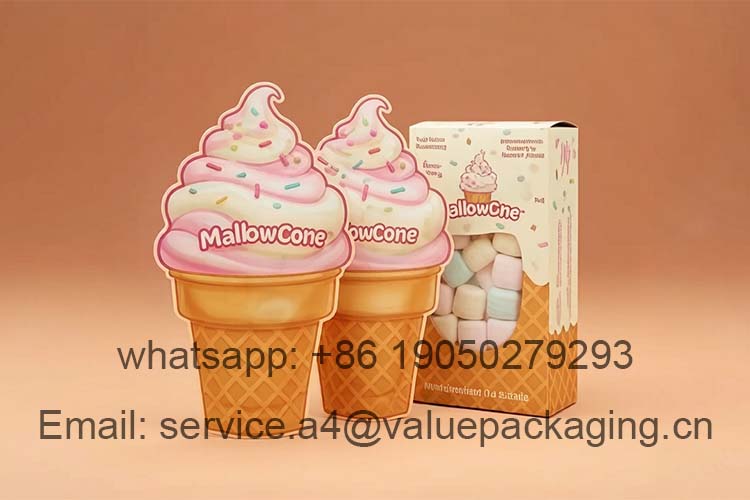
Shaped pouches (custom die-cut bags)
Shaped pouches are often used in novelty or children-oriented marshmallow products. These customized forms, such as cartoon shapes or themed outlines, enhance visual appeal and improve brand recognition. While they follow similar material structures as standard pouches, they are designed primarily for marketing impact and impulse purchases.
2. Key Requirements for Marshmallow Packaging
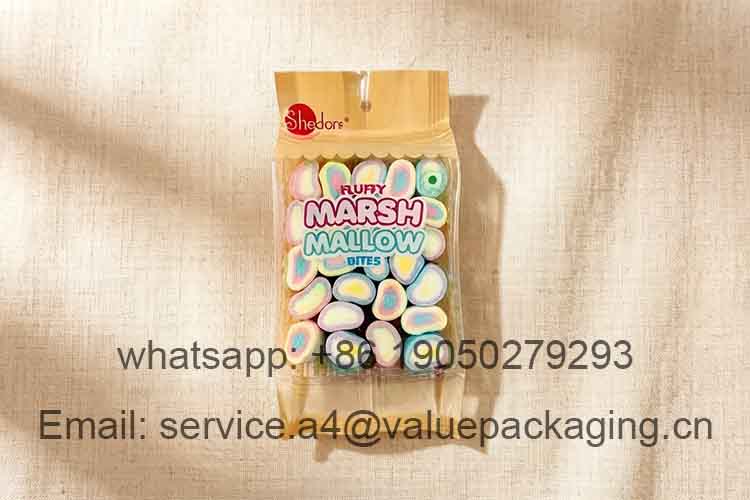
Compared with many low-moisture confectionery products, marshmallows require a more balanced packaging approach, as packaging must protect not only product freshness but also texture and appearance.
Moisture control
Moisture control is one of the most critical factors in marshmallow packaging. Excess humidity can cause stickiness and surface dissolution, while overly dry conditions may lead to hardening. Packaging should help maintain a relatively stable internal environment to preserve softness and product quality.
Seal integrity
Reliable sealing is essential to limit moisture exchange with the external environment, particularly under fluctuating storage conditions. Consistent seal performance also helps maintain shelf life and overall product stability.
Mechanical protection
Marshmallows are soft and easily compressed, making protection against deformation an important packaging function. Materials should provide sufficient strength to withstand stacking, transportation, and handling.
Oxygen barrier
Although oxygen is not the primary concern, it can still affect flavor stability over time. A moderate oxygen barrier is generally sufficient for most marshmallow packaging applications.
Based on these requirements, marshmallow packaging materials typically focus on balanced performance rather than extreme barrier properties. Unlike products requiring very high oxygen or moisture barriers, marshmallows generally need moderate moisture protection combined with reliable sealing and sufficient mechanical strength to preserve texture and protect product shape during handling and distribution.
Common materials include:
3. Material Selection in Marshmallow Packaging
| Main Component | Packaging Consideration | Why It Matters |
|---|---|---|
| Sugar and Corn Syrup | Moisture control | Hygroscopic ingredients can absorb humidity, causing stickiness or texture changes |
| Gelatin or Gelling Agents | Texture protection | Sensitive to moisture fluctuations that may affect softness and elasticity |
| Aerated Structure | Compression resistance | Lightweight foam structure can deform under pressure during transport |
| Flavorings and Colors | Light and oxygen protection | Helps maintain flavor stability and appearance over shelf life |
| Surface Coatings (Starch or Sugar Dusting) | Anti-caking and moisture protection | Prevents sticking and preserves product separation |
In practical applications, the choice of packaging structure often depends on the balance between moisture control, mechanical protection, cost, and product positioning. Different laminate structures provide varying levels of sealing reliability and durability, making them suitable for different marshmallow products and distribution conditions.
Typical Structures for Marshmallow Packaging
BOPP / CPP
This is one of the most widely used structures for marshmallow packaging, especially for pillow bags and standard retail packs. It offers good transparency, reliable sealing performance, and cost efficiency, making it suitable for fast-turnover products with standard shelf life requirements.
PET / PE
Compared with BOPP-based structures, this laminate provides better mechanical strength and slightly improved moisture stability. It is commonly used for products requiring greater durability during transportation and storage.
BOPP / PE
This is a cost-effective structure with basic protection, widely used for high-volume marshmallow products. It is generally suitable for products with relatively short distribution cycles and moderate packaging requirements.
4. Recyclable Mono-Material Marshmallow Packaging
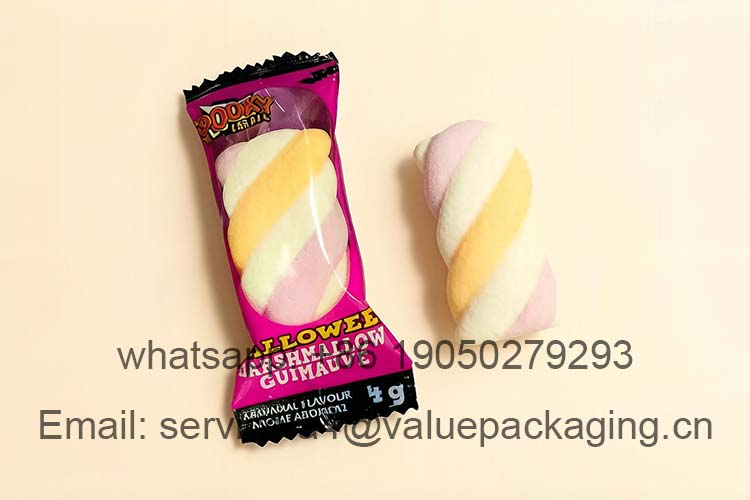
Under increasing sustainability requirements, mono material solutions are becoming a practical direction for marshmallow packaging. By keeping the structure within a single polymer family, these pouches are more compatible with existing recycling systems and help reduce the complexity associated with traditional multi-material laminates.
PE-based solutions for marshmallow packaging typically include:
Polyethylene structures are widely used due to their flexibility and reliable sealing performance. For marshmallows, they can provide stable moisture control under normal storage conditions while helping maintain package integrity during transportation and handling. Because marshmallows generally require moderate rather than extreme barrier performance, mono PE structures can meet practical needs in many short to medium shelf life applications.
Examples of recyclable mono material structures include:
- MDOPE/LDPE
- BOPE/LDPE
- MDOPE/BOPE/LDPE
These structures are designed to balance functionality with recyclability. While they do not provide the same overall performance as some conventional laminated structures, they can offer sufficient moisture protection and sealing reliability for many marshmallow products, particularly those with relatively fast turnover.
Compared with products requiring very high barrier protection, marshmallows are more compatible with mono material packaging because their packaging performance depends more on maintaining balanced moisture control and package integrity than on achieving extreme oxygen or moisture barriers. This makes recyclable mono-material solutions a more practical option in this category.
5. Compostable Marshmallow Packaging
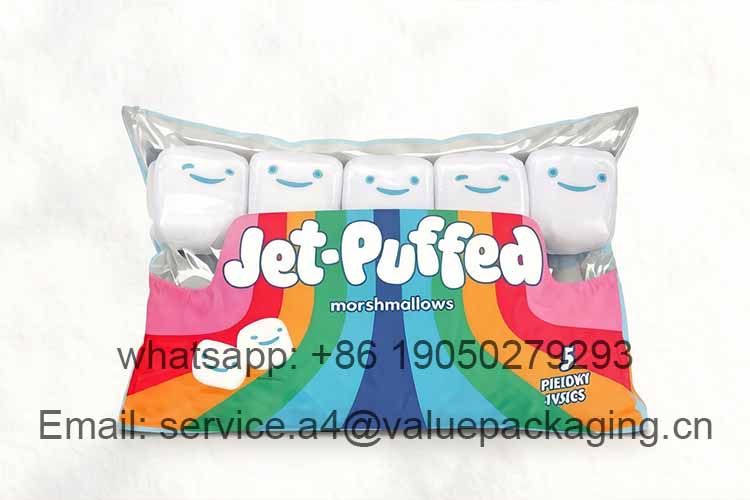
Another developing direction in marshmallow packaging is the use of compostable materials derived from renewable resources such as PLA, PBAT, and cellulose. These materials are designed to break down under industrial composting conditions, offering an alternative to conventional fossil-based plastics, particularly for brands with strong sustainability positioning.
Common compostable materials include:
In practical applications, these materials are rarely used as single layers. They are typically laminated to improve mechanical strength, sealing reliability, and moisture resistance. For marshmallows, packaging needs to help maintain a relatively stable internal environment to preserve softness and reduce the risk of stickiness or hardening caused by humidity fluctuations.
Typical compostable structures include:
- Kraft Paper/PLA+PBAT Membrane
- Cellulose/PLA+PBAT Membrane
- Cellulose/Metallized Cellulose/PLA+PBAT Membrane
- Kraft Paper/Metallized Cellulose/PLA+PBAT Membrane
Compared with conventional plastic laminates, compostable materials generally provide lower and less stable moisture barrier performance. For marshmallow packaging, this can be a limitation when products require long shelf life or are distributed in humid environments.
As a result, compostable packaging is generally more suitable for short to medium shelf life products or applications with relatively controlled storage conditions. Where improved protection is needed, multilayer compostable structures can help enhance performance, although they still typically do not match conventional laminates in overall barrier stability.
6. Conclusion
Marshmallow packaging focuses on maintaining softness, controlling moisture balance, and protecting product shape throughout storage and distribution. Unlike many dry confectionery products that rely mainly on barrier performance, marshmallow packaging requires a more balanced approach that combines moisture control, sealing reliability, and mechanical protection.
Conventional laminated structures remain widely used because they offer practical performance and cost efficiency across a wide range of applications. At the same time, recyclable mono-material and compostable solutions are gaining attention as sustainability becomes a stronger market driver, although maintaining consistent moisture protection remains a key consideration.
By selecting packaging materials and structures based on product format, shelf life requirements, and distribution conditions, brands can achieve a balance between product protection, shelf appeal, and environmental responsibility.