
As global consumers become more conscious about health and sustainability, superfoods such as goji berries are gaining remarkable popularity. Known for their high antioxidant content and nutritional value, goji berries are widely used in snacks, supplements, and functional foods. However, preserving the quality of this premium ingredient requires high-performance packaging.
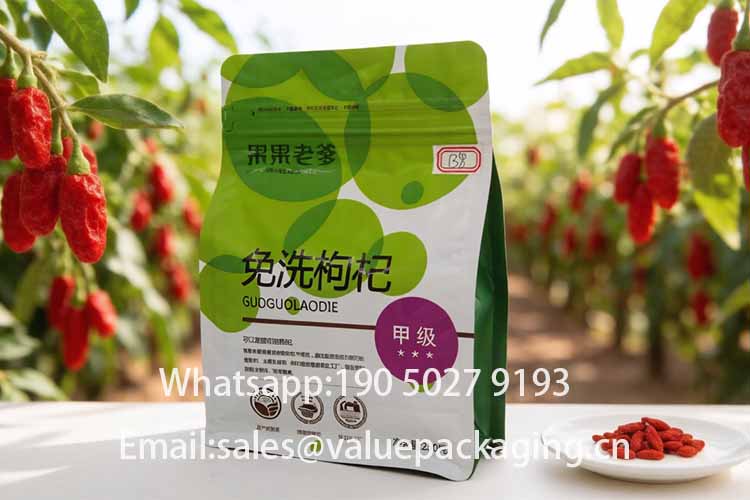
Current Packaging Materials Used for Goji Berry
Normal materials
The core of goji berry packaging lies in moisture-proofing, oxygen-barrier, and light-proofing to maintain its color and nutrients and prevent insect infestation. Below are some of the most common packaging material structures for dried goji berries:
| Materials | Applicable Scene |
| PET/LDPE | Short-term sales, mass-market economical packaging |
| PET/VMPET/LDPE | This is a mid-to-high-end retail packaging option for products requiring quality and a medium shelf life (e.g., 6-12 months). It is one of the most common goji berry packaging options on the market. |
| PET/AL/LDPE | High-end goji berry packaging for products with extremely high quality requirements, requiring long-term storage (e.g., over one year) |
| Matte BOPP/Kraft Paper/LDPE | Positioned in the mid-to-high-end market, the matte BOPP outer layer provides a delicate, high-end frosted feel, enhancing the visual appeal and significantly improving product grade and shelf attractiveness. |
| Matte BOPP/VMPET/LDPE | Natural and eco-friendly texture: The outer kraft paper provides a natural texture and feel, visually conveying the brand’s “natural, healthy, and environmentally friendly” philosophy |
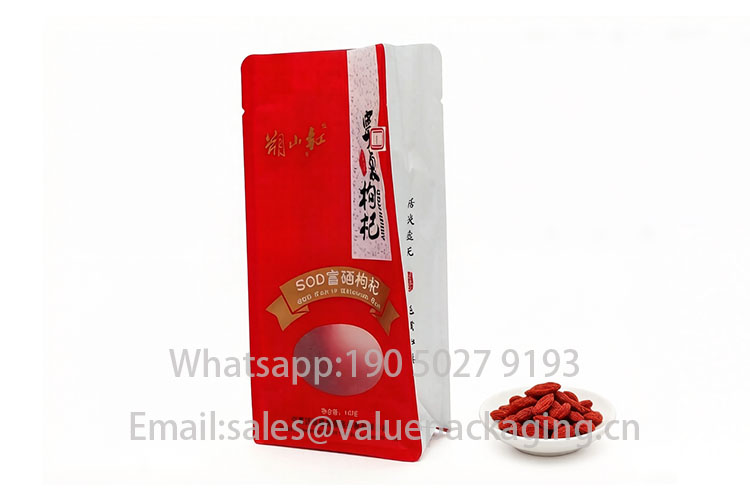
Many businesses today are willing to use transparent windows to showcase their products, enhance their appeal, and gain customer trust.
| Structure | Recommended | Reason |
| PET/AL/LDPE | Small transparent window | The pure aluminum foil body provides protection; please be advised to consume as soon as possible after opening. |
| PET/VMPET/LDPE | 30% transparent window | High cost-effectiveness. |
| Matte BOPP/Kraft Paper/LDPE | transparent window | Highlighting its eco-friendly qualities, it is suitable for rapid distribution. |
| PET/LDPE | Fully transparent | Lowest cost, best showcases the product, but short shelf life. |
Compostable Packaging
Compostable packaging typically uses bio-based materials like:
- BOPLA Film
- PLA+PBAT Film
- Kraft Paper
- Metallized Paper
- Cellulose Film
- Metallized Cellulose Paper
- PBS Film
- PVDC Coated Cellulose Film
These materials can be converted into high-quality stand-up pouches and rollstock packaging suitable for dried fruits and superfood powders.
Plant-based packaging materials are gaining popularity because they are derived from renewable resources and offer a lower environmental footprint compared with traditional petroleum-based plastics
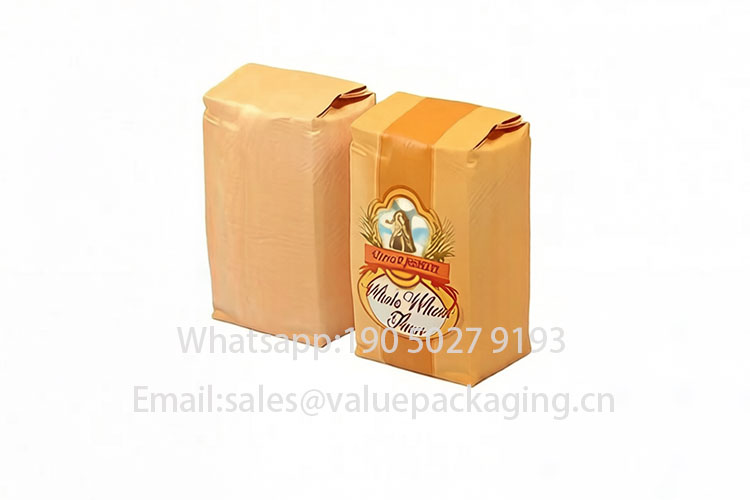
Typical compostable structures include:
- Metallized Paper/PLA+PBAT Membrane
It is more suitable for goji berry products with short shelf life (3-6 months), an emphasis on environmental protection, and fast shelf turnover. If used for long-term storage, the quality of goji berries is at higher risk of decline. - Cellulose/Metallized Paper/PLA+PBAT
| Biodegradable Foil Laminate | WVTR(g/m2/24hr) | OTR (cc/m2/24hr) |
| K-Cellulose22/Metallized Cellulose20/PLA+PBAT60 | 8 | 0.5 |
| Metallized Paper 69g/Cellulose30/PLA+PBAT60 | 5.6 | 1.12 |
| Cellulose30/Metallized Paper69g/PLA+PBAT60 | 8.9 | 1.1 |
Recyclable Mono-Material Packaging
Another important trend in sustainable packaging is the development of recyclable mono-material structures.
Traditional flexible packaging often combines multiple polymers, making recycling difficult. Mono-material packaging, however, uses compatible materials,typically polyethylene-based films,that can be recycled more easily.
Mono-material packaging uses a single polymer family, most commonly polyethylene (PE) and polypropylene (PP), across the entire structure.
a.PE Mono-Materials
b.PP Mono-Materials
We are now offering some full recyclable laminated based on PE and PP mono materials in the blow list.
1.MDOPE/BOPE/LDPE
2.MDOPE/BOPE/EVOH-LDPE
3.BOPP/CPP
4.BOPP/VMCPP
conclusion
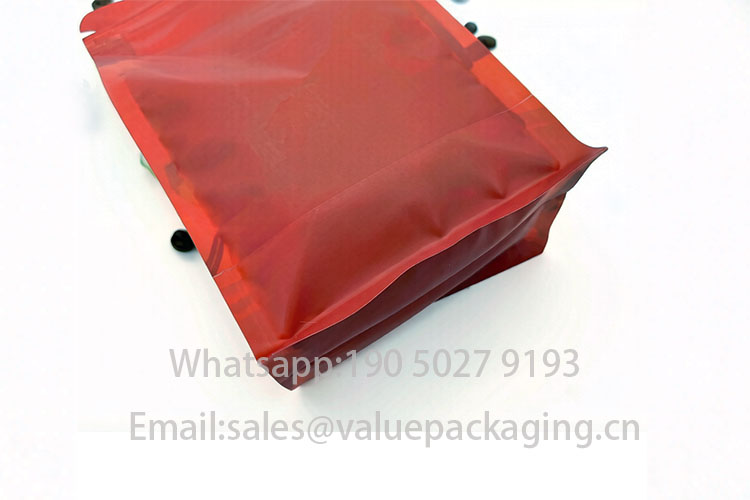
The packaging industry is rapidly evolving as sustainability becomes a global priority. In the superfood sector, several trends are shaping the future of goji berry packaging, including the growth of compostable packaging technologies, the expansion of recyclable mono-material films, and the increasing use of post-consumer recycled materials. At the same time, lightweight high-performance packaging structures are being developed to reduce material use while maintaining strong barrier protection. These innovations help brands lower environmental impact while ensuring the safety and quality of food products.