
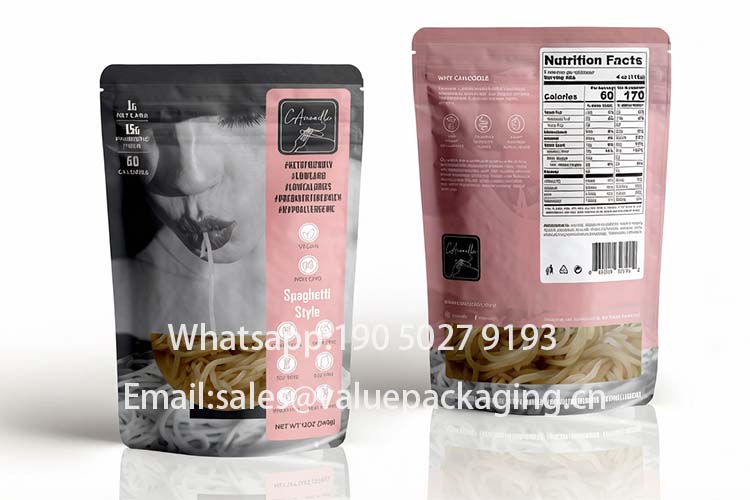
As consumer demand for sustainability continues to reshape the food industry, packaging has become a critical factor in brand differentiation,especially for premium products like spaghetti. Once dominated by traditional plastic bags and rigid cartons, the market is now rapidly evolving toward sustainable spaghetti packaging solutions that balance performance, shelf appeal, and environmental responsibility.
In this article, we explore the most widely used and emerging solutions in sustainable spaghetti packaging, focusing on three key categories:
- Conventional materials (optimized performance packaging)
- Compostable materials (bio-based and biodegradable solutions)
- Recyclable materials (mono-material circular packaging)
Conventional Materials for Spaghetti Packaging
Despite the push toward sustainability, conventional materials remain widely used in spaghetti packaging due to their reliability, cost efficiency, and strong barrier properties.
Common Structures
Typical structures for spaghetti packaging include:
- BOPP / CPP
- PET / LDPE
- Kraft Paper / LDPE
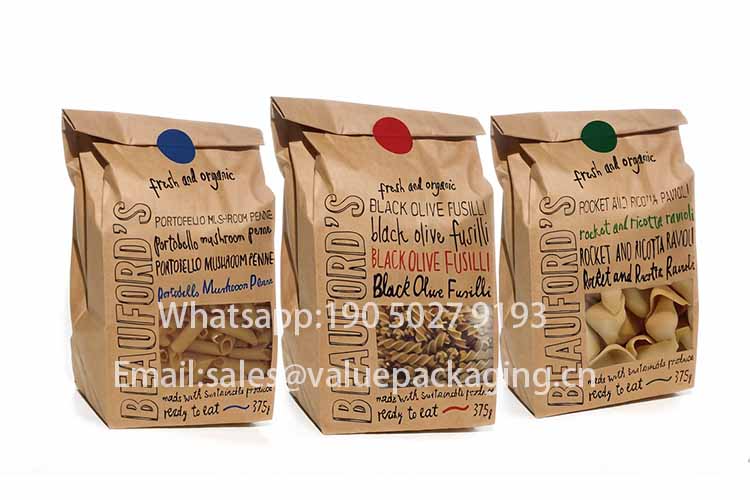
Why Conventional Materials Still Matter
Premium spaghetti requires packaging that protects against:Moisture absorption、Breakage during transportation、Contamination、Shelf-life degradation
Conventional plastic films offer:
High mechanical strength to prevent pasta breakage
Excellent seal integrity for long-term storage
Good transparency to showcase product quality
High-speed packing efficiency for large-scale production
Sustainable Packaging for Spaghetti
As sustainability becomes a core brand value, spaghetti packaging is evolving to balance product protection with environmental responsibility. Brands are increasingly adopting recyclable mono-material and compostable materials.
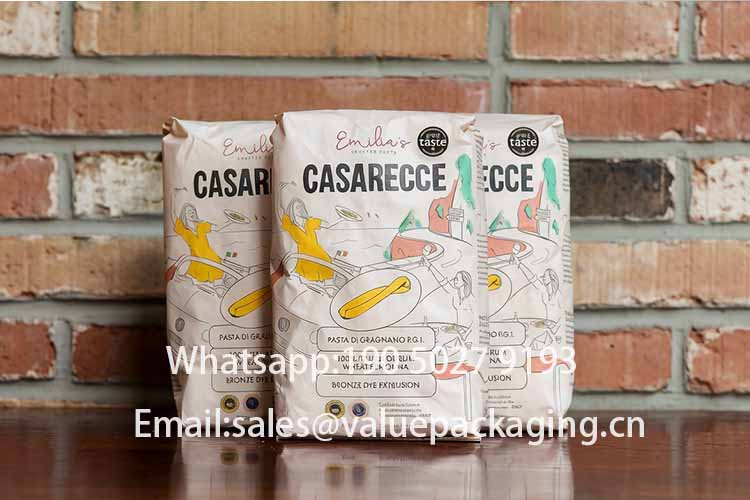
Compostable Packaging for Premium Spaghetti
As sustainability becomes a core brand value, compostable packaging is gaining traction,especially among organic and eco-conscious pasta brands.
Typical Compostable Structures
Common compostable solutions include:
- Kraft Paper / PLA+PBAT
- BOPLA/PLA+PBAT Membrane
- Paper / compostable barrier coating
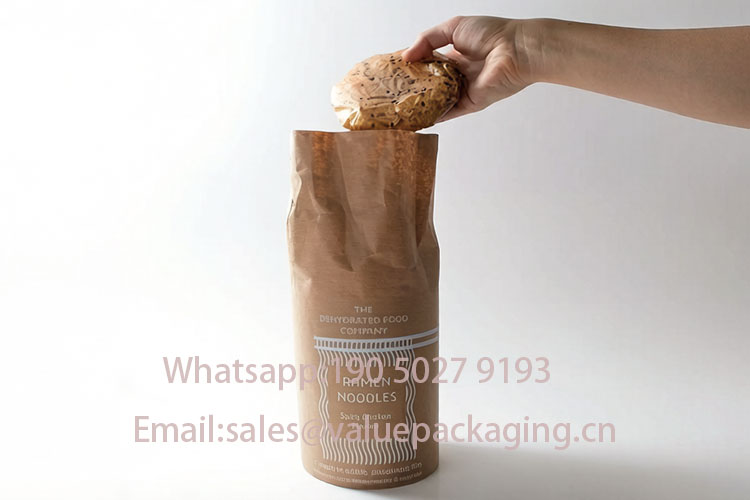
Advantages of Compostable Spaghetti Packaging
1. Renewable materials
PLA and cellulose films are derived from plant-based resources like corn starch or wood pulp, reducing dependence on fossil fuels
2. Biodegradability
Under industrial composting conditions, these materials break down into natural elements, minimizing environmental impact.
Limitations
While compostable packaging is attractive, it still has some challenges: the higher cost compared to conventional plastic and the limited moisture barrier compared to high-barrier laminates,also it is depended on industrial composting infrastructure.
Dependence on industrial composting infrastructure Despite these limitations, it remains a strong choice for brands prioritizing sustainability storytelling.
Recyclable Packaging for Spaghetti
Recyclable packaging is currently one of the most promising directions for sustainable spaghetti packaging, especially for large-scale commercial applications.
Mono-Material Structures
Typical recyclable structures include:
- MDOPE / LDPE
- BOPE / LDPE
- BOPP/CPP
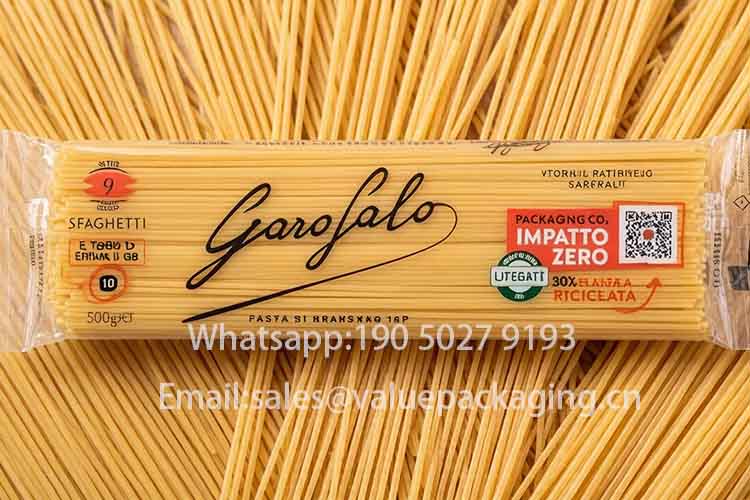
These materials are designed as mono-material solutions, making them compatible with existing recycling systems.
The Future of Sustainable Spaghetti Packaging
The evolution of eco friendly spaghetti packaging is being driven by innovation in materials and design.
Current advancements are driven by five interconnected trends.
First, the development of high-barrier recyclable films allows mono-material structures (like all-PE) to effectively replace multi-layer laminates, ensuring full recyclability without compromising protection.
Second, compostable materials are advancing, with significant improvements in durability and moisture resistance, making them viable for more applications.
Smart packaging design focuses on reducing overall material usage while enhancing functionality, such as through lightweighting and improved resealability. Finally, circular economy integration is becoming mainstream, with a growing emphasis on incorporating Post-Consumer Recycled (PCR) content into new packaging, closing the loop on plastic use.
Conclusion
Innovative sustainable packaging is transforming the premium spaghetti market. Today, brands have access to a wide range of solutions,from conventional high-performance materials to compostable and fully recyclable alternatives.
As consumer expectations continue to evolve, adopting sustainable spaghetti packaging is no longer optional,it is a strategic necessity for brands aiming to stand out in a competitive and eco-conscious market.