
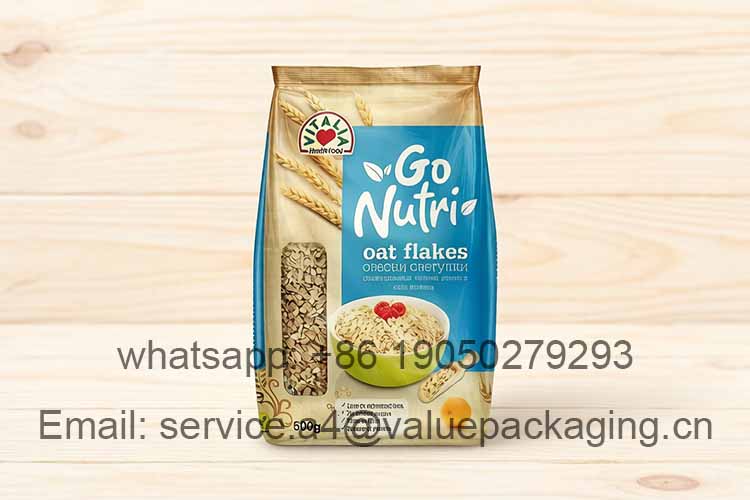
Oat flakes are a staple in many daily diets, valued for their nutrition, versatility, and long shelf life. However, despite being a dry product, oat flakes are highly sensitive to moisture and can easily lose their texture if not properly protected. This makes oat flakes packaging an important factor in maintaining product quality from production to consumption, while brands are also increasingly exploring more sustainable oat packaging solutions.
1. Common Oat Flakes Packaging Solutions
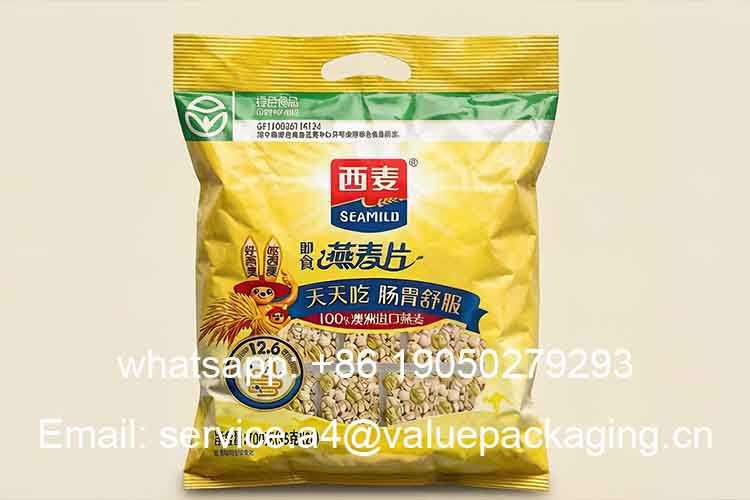
Oat flakes packaging is less about extreme barrier performance and more about keeping the product dry, clean, and easy to use over time. The most commonly used formats include:
Stand-up pouches with resealable zippers
These oat flakes pouches are widely used in retail. The resealable zipper helps limit moisture exposure after opening, which is especially important for products that are used gradually. The upright structure also improves shelf presentation while keeping the package easy to store and handle.
Flat bottom bags
Flat bottom oat packaging bags are often used for larger sizes. They provide excellent stability and a more structured appearance, making them suitable for both retail display and home storage. The box-like shape also allows for better space utilization during transport.
Side gusset bags
Side gusset oat flakes bags, also known as accordion-style bags, are commonly used for bulk or traditional packaging. The expandable sides increase filling capacity while maintaining a compact footprint, making them efficient for storage and transportation.
Single-Serve Sachets within Large Back-Seal Bags
Many large-format oat packs are designed to contain multiple single-serve sachets inside a back-seal bag. This approach combines the convenience of portion-controlled servings with the structural advantages of a larger pack. The back-seal bag provides stability and protection during storage and transportation, while the individually packed sachets maintain freshness and make it easy for consumers to take precise portions without exposing the entire batch to air or moisture.
2. Traditional Materials Used in Oat Flakes
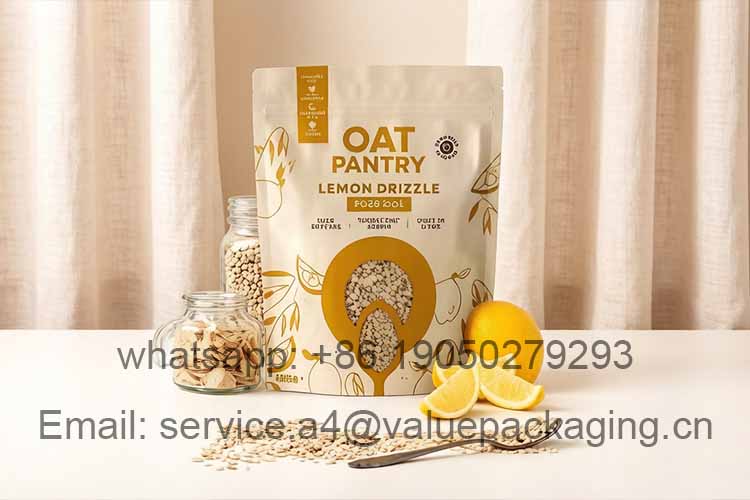
Compared with snacks like chips or coconut chips, oat flakes have a different set of priorities. The main concern is not breakage or oil migration, but stability during storage.
- Moisture control
Oat flakes are highly hygroscopic. Even small amounts of moisture can lead to softening or clumping, which directly affects usability. A consistent moisture barrier is therefore essential. - Oxidation control
Although not a high-fat product, oat flakes still contain natural lipids that can slowly oxidize. This is more noticeable in long shelf life or warm storage conditions. - Powder and cleanliness control
During handling and transport, oat flakes can generate fine particles. Packaging should prevent leakage and keep the product clean. - Seal reliability
A stable seal is critical, especially for large packs that are opened and closed multiple times. - Ease of use
Since oat flakes are often used daily, consumers expect packaging that is easy to open, reseal, and store.
To meet these needs, oat flakes packaging materials should focus on stable moisture barrier, good sealing performance, and sufficient durability rather than extreme barrier levels.
Common materials include:
- PET film
- VMPET film
- LDPE film
- BOPP film
- Kraft paper
- Metallized PET film
Typically, aluminum is used to enhance the barrier performance of packaging, but for oat packaging it is rarely employed for several reasons:
- Sufficient barrier from metalized films
Metalized films can provide adequate protection against light, oxygen, and moisture, which is generally enough to maintain the quality and shelf life of oats. Using a full aluminum layer is therefore unnecessary and can be avoided to save on material costs. - Prone to damage
Aluminum layers are rigid and brittle, making them susceptible to tearing, creasing, or puncturing during handling, forming, and transportation. This can compromise the packaging’s integrity and reduce product safety. - Cost efficiency
Avoiding aluminum layers not only simplifies production but also lowers overall material and manufacturing costs. Flexible alternatives such as PET/PE or metalized films achieve similar protective performance without the higher expense.
3. Sustainability Challenges in Conventional Oat Flakes Packaging
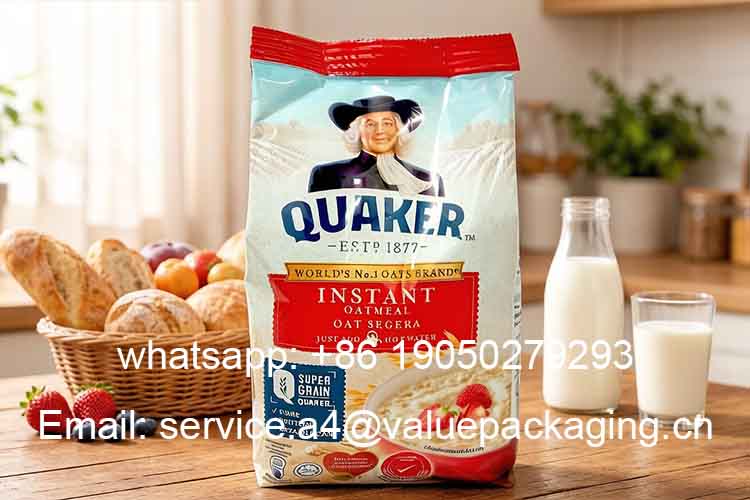
In practice, oat flakes packaging varies depending on positioning, shelf life, and cost targets. Different material combinations are used to balance moisture protection, structure, and appearance.
| Material Structure | Barrier Level | Key Advantages | Typical Applications |
|---|---|---|---|
| PET / LDPE | Basic | Cost-effective, flexible, suitable for short shelf life products | Entry-level retail packaging, fast-moving products |
| PET / VMCPP | Medium | Improved moisture and oxygen barrier, reliable sealing performance | Standard retail packaging with moderate shelf life requirements |
| PET / VMPET / LDPE | High | Strong barrier against oxygen and moisture, extends product freshness | Mainstream retail products and export packaging |
| PET / AlOx-PET / PE | High (Transparent) | Transparent barrier structure, balances visibility and protection | Premium retail packaging with product display window |
| BOPP (Single Layer) | Low | High clarity, lightweight, cost-efficient | Inner small sachets in bulk packaging, transparent multi-pack inner bags |
Selecting the right packaging material is critical for maintaining oat freshness, texture, and appearance. In practice, different laminate structures are chosen based on shelf life requirements, barrier performance, and product positioning. The following outlines common structures used in the industry, reflecting practical applications for varying preservation needs.
Short Shelf Life Applications
BOPP (Single Layer)
Single-layer BOPP offers high clarity, low cost, and good stiffness, making it suitable for inner sachets in bulk oat packaging or transparent small packs. However, it provides only limited moisture and oxygen barrier, so it is mainly used for short shelf life applications or secondary packaging where high protection is not required.
PET / LDPE
This structure is flexible, lightweight, and cost-effective, making it ideal for small packs or promotional oat products with immediate consumption. It provides basic moisture protection but has limited oxygen barrier, so it is best suited for products with minimal shelf life requirements or fast-moving retail packs.
Standard Shelf Life Applications
PET / VMCPP
Widely used for standard retail oat packaging, PET/VMCPP offers improved moisture and oxygen barrier compared with PET/LDPE, while maintaining good printability and heat-sealing performance. It balances durability and visual appeal, making it suitable for everyday retail productas with moderate shelf life expectations.
Medium to Long Shelf Life Applications
PET / VMPET / PE
This high-barrier structure protects oats against both oxygen and moisture, effectively extending freshness. Its mechanical strength and durability make it appropriate for medium to large retail packs, export products, or oats that require longer storage and transport periods.
PET / AlOx-PET / PE
Combining high barrier performance with transparency, this structure allows consumers to see the product while keeping it fresh. It is particularly suitable for premium retail packaging or window pouches, providing both protection and shelf appeal.
Most of these structures rely on multi-material laminations , which offer varying levels of protection but are difficult to separate for recycling. Choosing the right combination depends on balancing freshness, durability, and visual presentation according to the target market and product positioning.
4. Recyclable Mono Material Oat Flakes Packaging
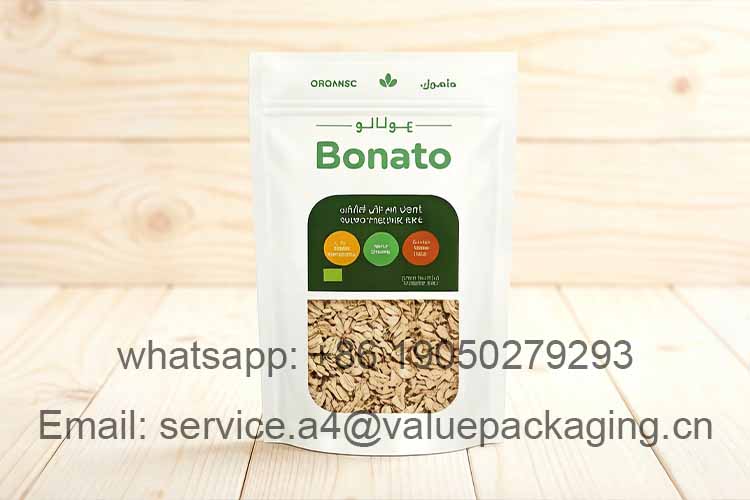
To improve recyclability, packaging designers are increasingly turning to mono-material solutions. By staying within a single polymer system rather than combining multiple different materials, these structures are simpler to process and recover after disposal, making them more environmentally compatible.
Common polyethylene based materials include:
Common PP-based materials include:
These films can be combined in different ways to create laminate structures that still provide the moisture protection oat flakes require.These combinations are carefully designed to retain product quality while improving compatibility with recycling systems.
Typical structures include:
- BOPP/VMCPP
- MDOPE/LDPE
- BOPE/LDPE
- MDOPE/BOPE/LDPE
- BOPP/VMCPP
- ABOPP/VMCPP
For oat flakes, this approach is particularly suitable because moisture resistance is more critical than achieving an extremely high oxygen barrier. Both PE and PP mono-material structures can effectively protect product texture, prevent moisture absorption, and maintain overall package integrity.
By adopting these mono-material formats, brands can achieve a balanced solution that supports product protection, production efficiency, and environmental sustainability, making them suitable for both everyday retail packaging and more premium applications.
5. Compostable Oat Flakes Packaging
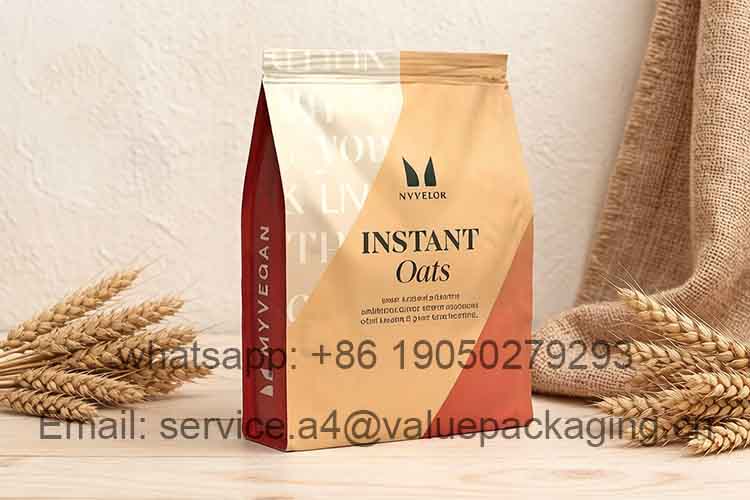
Another promising direction is compostable packaging made from renewable materials. These solutions are designed to minimize long-term environmental impact and appeal to brands with a strong sustainability focus, while still meeting the functional requirements of oat packaging.
Common compostable materials include:
In practical use, these materials are often combined to improve strength and barrier performance.
Typical structures include:
- Cellulose/PLA+PBAT Membrane
- Cellulose/Metallized Cellulose/PLA+PBAT Membrane
- Kraft Paper/Metallized Cellulose/PLA+PBAT Membrane
For oat flakes, moisture control remains the primary challenge. Compostable packaging must be carefully engineered to prevent clumping and maintain product flowability during storage and handling. With proper design, compostable laminates can offer a balance of sustainability, protection, and usability, making them suitable for retail, premium, and environmentally conscious product lines.
Barrier Properties of Compostable Laminates
| Biodegradable Foil Laminate | WVTR(g/m2/24hr) | OTR (cc/m2/24hr) |
| Cellulose20/Metallized Cellulose20/PLA+PBAT60 | 18 | 2.1 |
| Cellulose20/Metallized Cellulose20/BOPLA40 | 19 | 2.2 |
| K-Cellulose22/Metallized Cellulose20/PLA+PBAT60 | 8 | 0.5 |
| Metallized Paper 69g/Cellulose30/PLA+PBAT60 | 5.6 | 1.12 |
6. Conclusion
Oat flakes packaging is less about extreme protection and more about consistency. Keeping the product dry, easy to use, and stable over time is the main objective.
As sustainability becomes more important, recyclable mono material pouches and compostable solutions are gradually being adopted. At the same time, packaging still needs to meet basic performance requirements, especially in terms of moisture barrier and sealing reliability.
By focusing on these practical needs, brands can deliver packaging that supports both product quality and environmental goals without overengineering the structure.