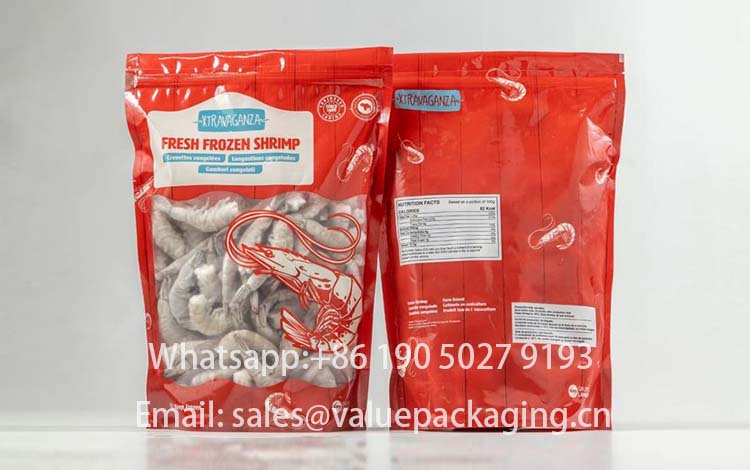
Frozen shrimp is one of the fastest-growing categories in the global seafood industry. From retail supermarkets to foodservice distribution channels, consumers increasingly demand convenient, high-quality frozen shrimp products with extended shelf life and reduced environmental impact. As sustainability becomes a key purchasing factor, seafood brands are actively seeking eco-friendly packaging solutions that protect product quality while supporting corporate sustainability goals.
Flexible packaging has emerged as a preferred option for frozen shrimp because it combines lightweight construction, excellent barrier performance, reduced material consumption, and improved transportation efficiency. Today, innovative recyclable and compostable flexible packaging structures are helping seafood companies balance performance, food safety, and environmental responsibility.
Packaging Challenges for Frozen Shrimp
Frozen shrimp presents unique packaging requirements compared with dry foods or ambient products.
During storage and distribution, shrimp products are typically maintained at temperatures of approximately -18°C (0°F) or lower. Packaging materials must remain durable under frozen conditions while protecting the product from moisture loss, oxidation, freezer burn, and mechanical damage.
The primary packaging challenges include:
- Low-temperature brittleness
- Freezer burn prevention
- Oxygen exposure
- Moisture migration
- Seal integrity during freezing and thawing
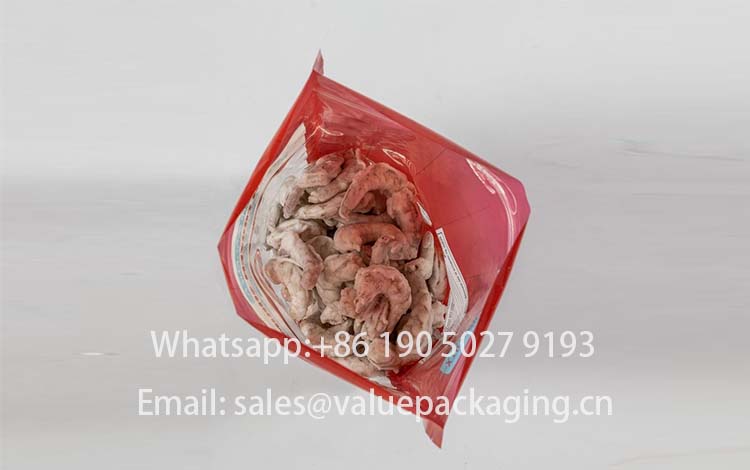
- Puncture resistance from shrimp shells and tails
- Long-distance cold-chain transportation
For these reasons, frozen shrimp packaging requires a combination of strong moisture barriers, oxygen barriers, and mechanical durability.
Key Barrier Requirements for Frozen Shrimp Packaging
Two critical technical indicators determine packaging performance:
WVTR (Water Vapor Transmission Rate)
WVTR measures the amount of water vapor passing through a packaging material.
Low WVTR helps prevent:
- freezer burn
- dehydration
- weight loss
- texture deterioration
Recommended target:
| Property | Recommended Value |
|---|---|
| WVTR | ≤ 1 g/m²·day |
OTR (Oxygen Transmission Rate)
OTR measures oxygen permeability.
Low OTR helps protect:
- flavor
- color
- freshness
- nutritional quality
Recommended target:
| Property | Recommended Value |
|---|---|
| OTR | ≤ 5 cc/m²·day |
Traditional Frozen Shrimp Packaging Structures
PET/LDPE
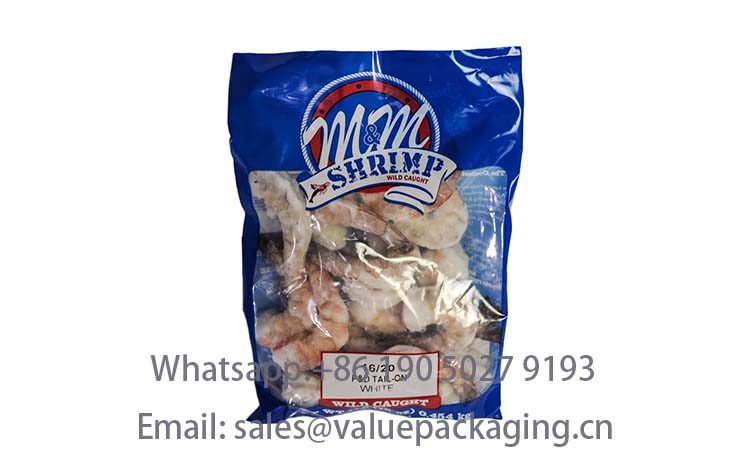
PET/PE is one of the most commonly used frozen seafood packaging structures.
This is a highly cost-effective and practical combination. PET provides good mechanical strength and printability, while PE offers excellent heat-sealing properties and a certain degree of toughness.
Typical performance:
| Structure | WVTR | OTR |
|---|---|---|
| PET/PE | 3–8 | 80–200 |
While suitable for short-term storage, barrier performance may be insufficient for premium export products.
PA/LDPE
This is currently a mainstream choice offering excellent overall performance. The nylon layer imparts superior puncture resistance to the film, effectively withstanding the sharp spines of frozen shrimp.
Recyclable Packaging Solutions for Frozen Shrimp
The seafood industry is increasingly transitioning toward recyclable mono-material packaging structures.
MDOPE/BOPE/EVOH-LDPE
The key lies in the incorporation of a BOPE layer, which,while maintaining high barrier properties—further enhances puncture resistance and improves eco-friendliness, making it an ideal choice for premium products and eco-conscious export markets.
Typical performance:
| Structure | WVTR | OTR |
|---|---|---|
| MDOPE/BOPE/EVOH-LDPE | 0.8–2.5 | 0.3–5 |
This structure is increasingly used for:
- frozen shrimp pouch
- frozen seafood bag
- IQF shrimp packaging
- premium export seafood packaging
MDOPE/EVOH-LDPE
The key lies in utilizing a co-extruded EVOH layer to achieve high barrier performance; this is a mainstream, high-performance solution that balances freshness preservation with cost-effectiveness.
For applications requiring excellent recyclability and cost efficiency:
| Structure | WVTR | OTR |
|---|---|---|
| MDOPE/EVOH-LDPE | 1–3 | 0.5–10 |
Can Compostable Packaging Be Used for Frozen Shrimp?
This is one of the most frequently asked questions in sustainable seafood packaging.
Recent developments in compostable flexible packaging have significantly improved frozen-food performance.
Biodegradable Pouch Samples
Our compostable flexible pouches are primarily produced from biopolymer film materials, including kraft paper, metallized paper, cellulose, metallized cellulose, BOPLA film, PLA+PBAT film, and PBS film. The following are some examples of commercial compostable foil laminates.
- Kraft Paper/PLA+PBAT
- Kraft Paper/BOPLA
- Cellulose/PLA+PBAT
- Kraft Paper/PBS Foil
- Metallized Paper/PLA+PBAT
- BOPLA/PLA+PBAT
- Cellulose/Metallized Cellulose/PLA+PBAT
- Kraft Paper/Metallized Cellulose/PLA+PBAT
- Cellulose/Metallized Paper/PLA+PBAT
- Kraft Paper/Cellulose/PLA+PBAT
- Kraft Paper/Cellulose/PBS
- Metallized Paper/Cellulose/PLA+PBAT
Cellulose/Metallized Cellulose/PLA+PBAT
This structure offers one of the strongest compostable barrier systems currently available.
Typical performance:
| Structure | WVTR | OTR |
|---|---|---|
| Cellulose/Metallized Cellulose/PLA+PBAT | 0.5–2 | 0.5–5 |
For frozen shrimp applications, validation testing under actual cold-chain conditions is recommended before commercialization.
Frozen Treat Conditions of Biodegradable Pouch
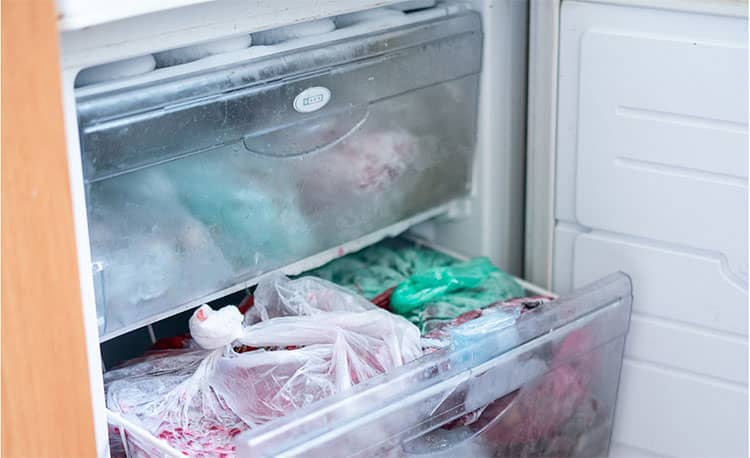
We will fill the biodegradable pouches with water, and place them in the refrigerator under the following conditions.
Freezing Temperature: -18 ° Celsius (- 0.4 ° Fahrenheit)
Period: 72 Hours
Test Video
You are advised to watch the video below to have a further understanding of this frozen treatment and the drop test.
The compostable flexible pouches are well-suited for frozen treatment, which enables them to be accepted by some frozen food markets. The great mechanical strength of the compostable pouches will provide good protection for up to 10 kilograms of products.
Future Sustainability Trends in Frozen Seafood Packaging
The frozen seafood industry is expected to accelerate adoption of:
- recyclable mono-material PE structures
- MDOPE technology
- EVOH barrier systems
- downgauged packaging films
- compostable high-barrier laminates
- carbon footprint reduction initiatives
Retailers and consumers increasingly expect seafood brands to reduce packaging waste without compromising product protection.
As a result, sustainable flexible packaging is becoming a critical competitive advantage in the frozen seafood market.
Conclusion
Frozen shrimp packaging requires a careful balance between barrier performance, cold-chain durability, and environmental responsibility. Traditional structures such as PET/VMPET/LDPE and PET/AL/LDPE continue to provide excellent protection against oxygen, moisture, and freezer burn. However, modern recyclable structures such as MDOPE/BOPE/EVOH-LDPE and MDOPE/EVOH-LDPE are rapidly emerging as sustainable alternatives capable of supporting circular economy objectives while maintaining product quality.
For brands pursuing even greater environmental benefits, advanced compostable structures such as Cellulose/Metallized Cellulose/PLA+PBAT offer promising opportunities for future frozen seafood packaging innovation. By selecting the right pouch, bag, sachet, packet, or pack format, frozen shrimp manufacturers can improve shelf life, reduce environmental impact, and meet the growing demand for sustainable seafood packaging solutions.