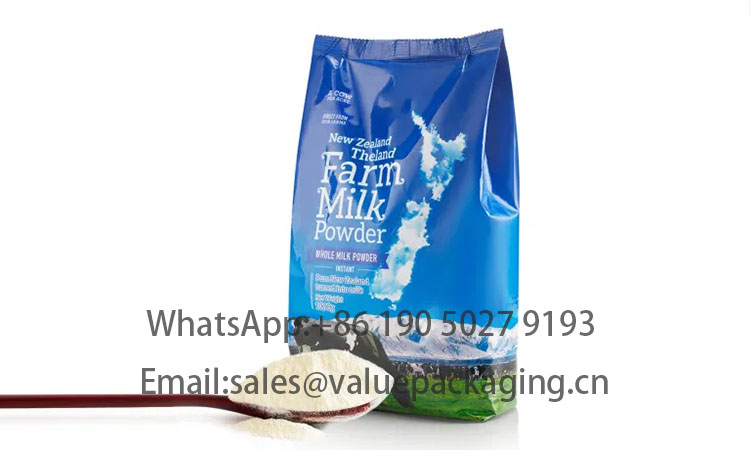
The global dairy industry is facing a massive wake-up call. Consumers are no longer just looking at nutritional labels; they are looking at the packaging itself. However, creating sustainable packaging for milk powder is one of the toughest challenges in the food industry.
Unlike stable dry goods like rice or pasta, milk powder is a highly sensitive, chemically complex product.Transitioning to green packaging isn’t just a matter of switching from plastic to paper,it requires a deep understanding of food science, barrier technology, and shelf-life preservation.
Common Packaging Formats
Side gusset bags
Side gusset bags feature expandable side panels that increase filling capacity without significantly increasing footprint. This structure improves stacking performance and is suitable for medium to large pack sizes, especially for bulk retail and transportation.
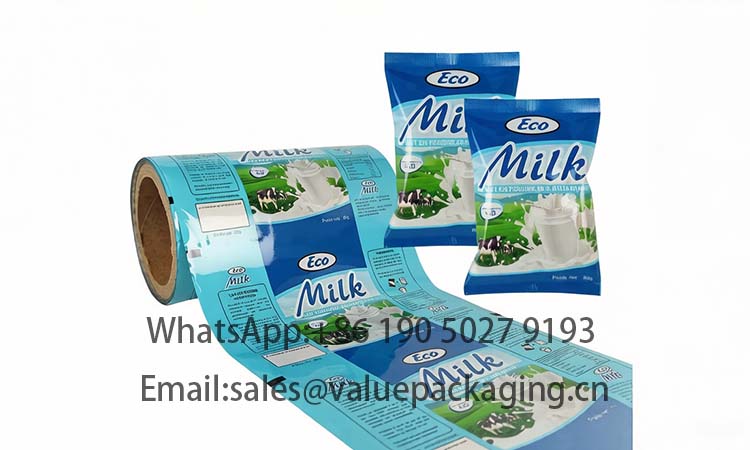
Back seal bags (pillow bags)
Back seal bags, also known as pillow bags, are the most widely used format for small to medium detergent powder packs. The longitudinal seal runs along the back of the package, allowing efficient forming and sealing on high-speed filling lines. This structure offers excellent cost efficiency and is ideal for mass-market products with large production volumes.
The Core Challenge: Understanding Milk Powder Characteristics
To understand why milk powder packaging is so difficult to re-engineer, we must first look at what happens to the powder when it is exposed to the elements. Milk powder contains high levels of lipids (fats), proteins, and lactose. It is incredibly vulnerable to three main environmental factors:
- Moisture: Milk powder is highly hygroscopic. If water vapor penetrates the package, the powder quickly absorbs it, leading to caking, lumping, and a severe drop in solubility.
- Oxygen: The unsaturated fatty acids in whole milk powder and infant formula oxidize rapidly when exposed to oxygen. This results in rancidity, off-flavors, and the destruction of vital vitamins (like Vitamin A and C).
- Light UV Degradation: Light catalyzes lipid oxidation and degrades riboflavin (Vitamin B2), altering both the color and nutritional value of the milk.
Common Packaging Formats for Milk Powder
PET/AL/LDPE
PET/VMPET/LDPE
PET/AL/PET/LDPE
MatteBOPP/AL/LDPE
Barrier Performance
| Structure | OTR | WVTR |
| PET/AL/LDPE | ~0 cc/m²·day | 0–0.1 g/m²·day |
| PET/VMPET/LDPE | 0.5–5 cc/m²·day | 0.5–1.5 g/m²·day |
| PET/AL/PET/LDPE | ~0 cc/m²·day | 0–0.05 g/m²·day |
| Matte BOPP/AL/LDPE | ~0 cc/m²·day | 0–0.2 g/m²·day |
The OTR of AL (aluminum foil) structure is close to 0, and the WTR is extremely low (0-0.2). VMPET (vacuum-metallized PET) structure has certain OTR and WTR values, but its barrier properties are significantly lower than AL. Key difference: AL provides near-perfect barrier properties (oxygen and moisture), while VMPET, although offering good barrier properties, still allows for trace amounts of permeability.
AL is a “near-perfect” barrier, but it is susceptible to bending; VMPET is a “cost-effective” choice, offering good barrier properties and greater durability. For milk powder packaging, the AL structure is preferred when shelf life and moisture control are extremely critical; for standard shelf-life requirements, the VMPET structure is sufficient.
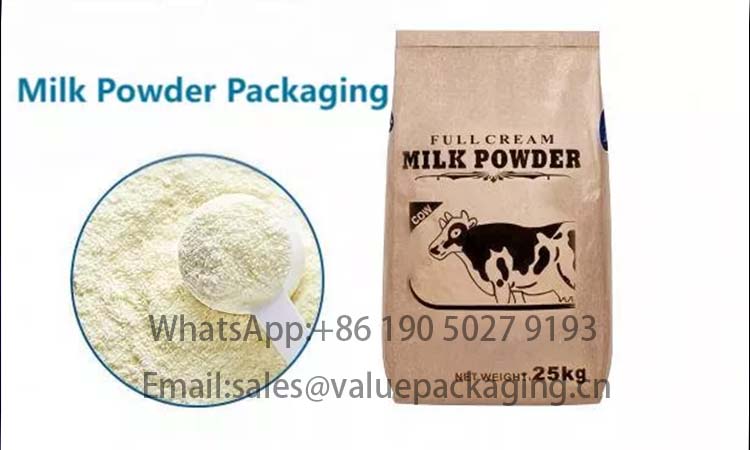
Compostable Milk Powder Packaging Materials
Compostable packaging is gaining attention among eco-conscious brands, especially for organic and premium dairy products.
However, compostable structures still face challenges in achieving ultra-high barrier performance.
Compostable Substrates
- BOPLA Film
- PLA+PBAT Film
- Kraft Paper
- Metallized Paper
- Cellulose Film
- Metallized Cellulose Paper
- PBS Film
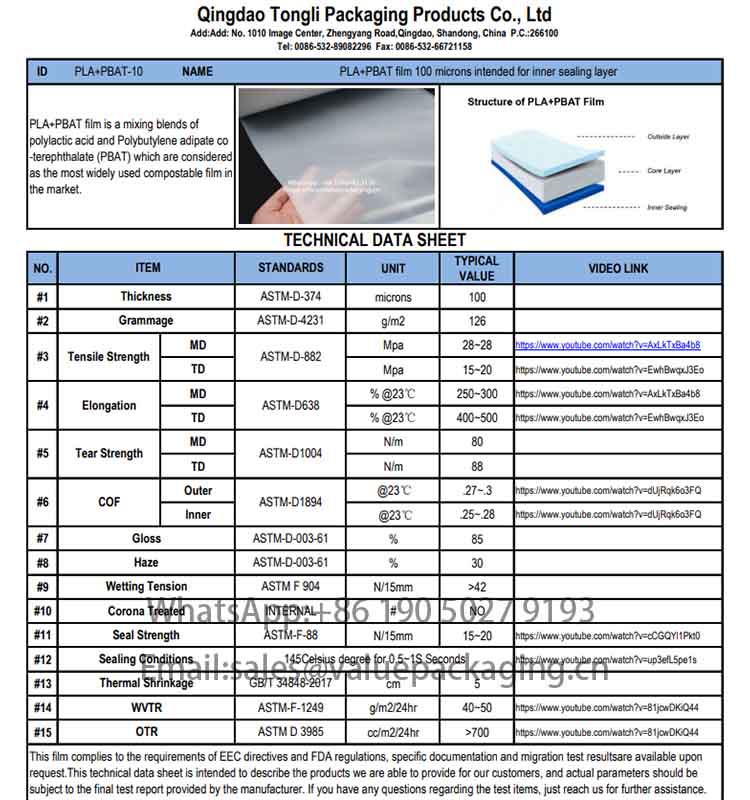
The PLA+PBAT film is the most common biodegradable film commercialized in various demanding market, which actually contains PLA (poly lactic acid) (70~85%) blended with polybutylene adipate terephthalate (PBAT) (10~20%) and plasticizer (2~10%). With great mechanical strength, physical stability, great sealing performance and printability, this film is now extending its packaging application for more and more products.
Due to different understanding on this blended film, some people may just call it PLA Film, as actually PLA (Poly Lactic Acid) occupies the largest content of its formulation.
Actually, there are two kinds of biopolymer resins in this formulation, with PBAT not able to be neglected, so usually for industries, the professionals will call it PLA+PBAT film, which is able to describe the film in a better understanding.
Plasticizer is added into the formulation, which works as the aid agent in the manufacturing process, which enables the final film with optimized property, such as silicon dioxide in producing traditonal plastic film, so people usually do not mention it when trying to name the final film.
Compostable Laminates
Cellulose/Metallized Cellulose/PLA+PBAT Membrane
| Property | Typical Value |
|---|---|
| WVTR | 0.5–2 g/m²·day |
| OTR | 0.5–5 cc/m²·day |
This is one of the best compostable high-barrier structures currently available.
Metallized cellulose films offer excellent barriers against oxygen, moisture, and aroma, enhancing a sustainable image, while the PLA+PBAT layer ensures good sealing performance.
K-Cellulose22 / Metallized Cellulose20 / PLA+PBAT60
| Property | Typical Value |
|---|---|
| WVTR | 8 g/m²·day |
| OTR | 0.5 cc/m²·day |
Metallized cellulose provides very strong oxygen protection.And compared with standard cellulose films, metallized cellulose significantly improves WVTR performance.All layers belong to industrial compostable material systems.
Cellulose/Metallized Paper/PLA+PBAT Membrane
| Property | Typical Value |
|---|---|
| WVTR | 5.6 g/m²·day |
| OTR | 2–10 cc/m²·day |
Recyclable Milk Powder Packaging
As global sustainability regulations become stricter, brands are transitioning toward recyclable mono-material packaging systems.
PE Mono Materials
PE Mono-Material Laminate
MDOPE/BOPE/EVOH-LDPE
MDOPE/EVOH-LDPE
MDOPE/MDOPE/EVOH-LDPE
MDOPE/BOPE/APE
MDOPE/BOPE/EVOH-LDPE
| Property | Typical Value |
|---|---|
| WVTR | 0.8–2.5 g/m²·day |
| OTR | 0.3–5 cc/m²·day |
MDOPE offers stiffness and printability, while BOPE, with its balanced biaxial tensile properties, significantly improves the puncture resistance of the entire package, providing additional protection and balanced performance.
| Property | Typical Value |
|---|---|
| WVTR | 1–3 g/m²·day |
| OTR | 0.5–10 cc/m²·day |
It has a simple structure, mature technology, and relatively low cost, but it is not as good as structure MDOOE/BOPE/LDPE in terms of comprehensive mechanical properties such as puncture resistance.
Conclusion
Milk powder packaging requires extremely high barrier protection due to the product’s sensitivity to oxygen and moisture. Traditional structures such as PET/AL/PE and PET/VMPET/PE continue to dominate because of their exceptional barrier performance and long shelf-life protection.
However, the packaging industry is rapidly evolving toward more sustainable solutions. Recyclable mono-material structures such as MDOPE/EVOH-PE are emerging as highly promising alternatives that balance recyclability with strong oxygen and moisture barrier performance. Compostable materials, are also gaining interest in premium eco-focused dairy markets.
As sustainability regulations and consumer expectations continue increasing, future milk powder pouch, bag, sachet, packet, pack, and doypack packaging will increasingly rely on innovative recyclable and compostable materials that support both circular economy goals and product safety requirements.