
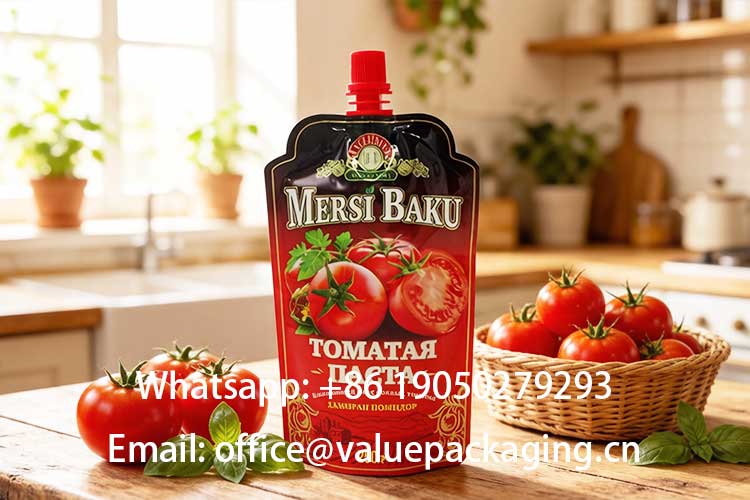
In the global sauce market, sustainability has become an increasingly important factor influencing ketchup packaging and overall sauce packaging decisions. As consumers become more aware of environmental issues, brands are under growing pressure to adopt sustainable packaging solutions that reduce waste while maintaining product safety and convenience.
Ketchup is one of the most widely consumed sauces worldwide, making ketchup packaging a key factor in both product protection and environmental impact. To develop more sustainable ketchup packaging, it is essential to first understand the current packaging landscape, its limitations, and the emerging materials and technologies that may shape the future of eco friendly sauce packaging.
1.The Current Landscape: Traditional Ketchup Bags
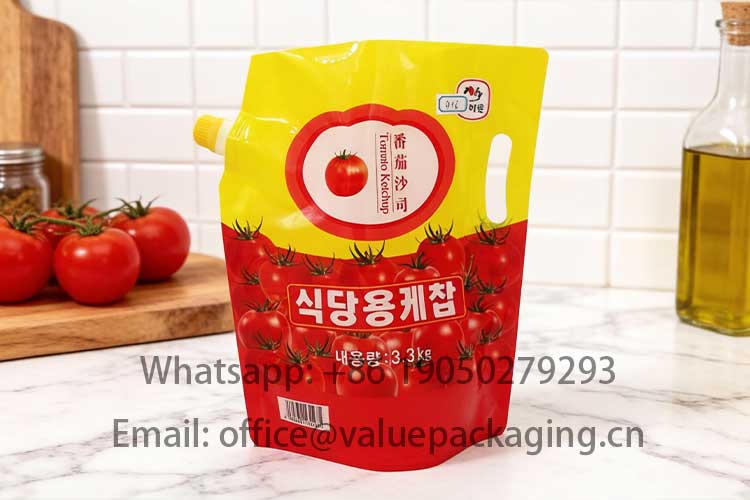
Ketchup is a viscous sauce that requires packaging with strong sealing performance, oxygen resistance, and leak prevention. To meet these requirements, packaging solutions often differ depending on the target market and product size.
Common Packaging Materials for Ketchup:
In the retail consumer market, ketchup is often packed in small portion pouches designed for longer shelf life and convenient single use. These products require stronger barrier protection to maintain freshness during extended storage. Aluminum foil is therefore widely used as the core barrier layer because it provides excellent resistance to oxygen, light, and moisture, helping extend product shelf life and preserve flavor.
In food service, takeaway, and catering applications, ketchup is more commonly packed in larger doypacks intended for faster consumption and shorter shelf life. In this segment, packaging structures often focus more on cost efficiency while maintaining basic protection. VMPET film is commonly used because it offers a balanced combination of moderate barrier performance and lower cost compared with aluminum foil. For large volume packaging with very fast consumption, some structures may even use double PA laminates, focusing mainly on durability and cost efficiency rather than high barrier performance.
2.Why Traditional Ketchup Pouches Falls Short in Sustainability
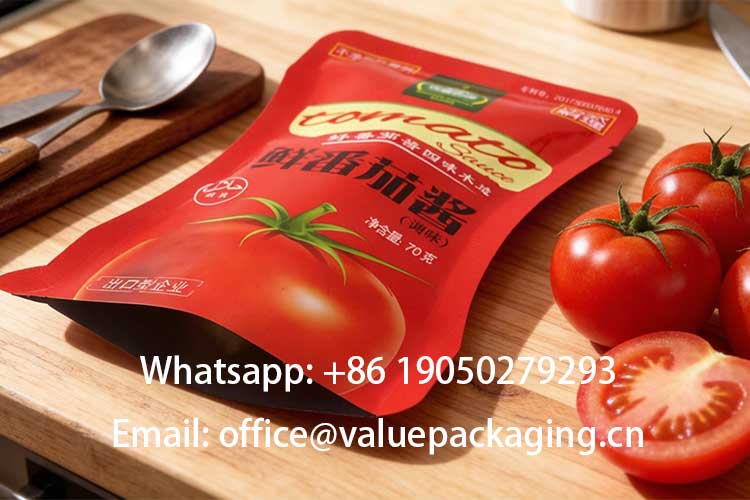
Barrier performance is essential in ketchup pouch packaging. By combining different films and functional layers, multilayer laminates can provide improved mechanical strength, sealing reliability, and extended shelf life. These structures help maintain product stability throughout storage, transportation, and distribution.
Premium Structures with Aluminum Foil:
These structures use aluminum foil as the core barrier layer, providing excellent protection against oxygen, moisture, and light. Because of the strong barrier performance, they are widely used in higher end retail ketchup products that require longer shelf life and stable product quality during storage and distribution.
Cost-Oriented Structures with Metallized Films:
- BOPP / VMPET / LDPE
- PET/VMPET/LDPE
- PA/PA/LDPE
- BOPP/VMPET/PA/LDPE
In more cost-sensitive applications, metallized PET is often used as the main barrier layer. VMPET offers moderate barrier performance while significantly reducing material cost compared with aluminum foil. These structures are commonly used in food service packaging or larger volume ketchup pouches with faster consumption cycles.
In some large volume applications with very fast product turnover, structures such as PA / PA / LDPE may also be used, focusing more on mechanical strength and cost efficiency rather than very high barrier protection.
3. Why Mono-Material Ketchup Pouches Are Becoming A Trend
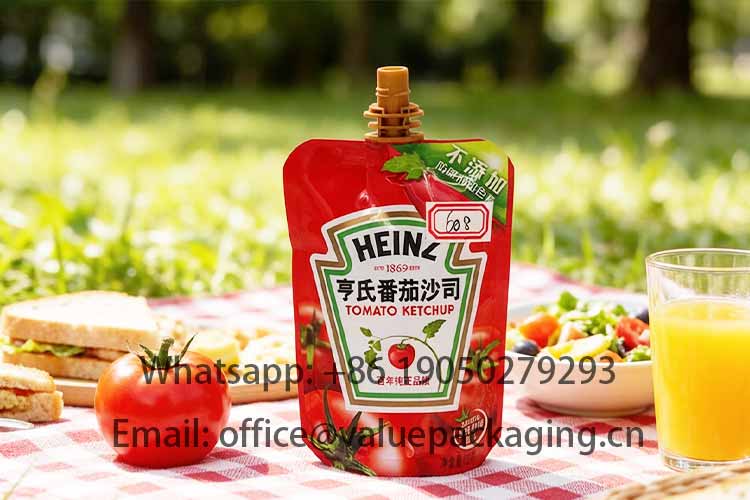
To improve environmental performance, packaging manufacturers and condiment brands are increasingly exploring ways to make ketchup pouch packaging more sustainable. As environmental awareness continues to grow, companies are seeking solutions that can reduce material complexity while still maintaining the protection and convenience required for sauce products.
Several key directions are currently being explored within the packaging industry:
- Mono PE recyclable pouches
- Compostable flexible packaging
Among these options, mono material flexible packaging has attracted particularly strong interest in recent years. By simplifying the material structure and reducing the number of different polymers used in a pouch, these designs aim to improve compatibility with existing recycling systems.
Mono Material Pouches as a Practical Recyclable Solution
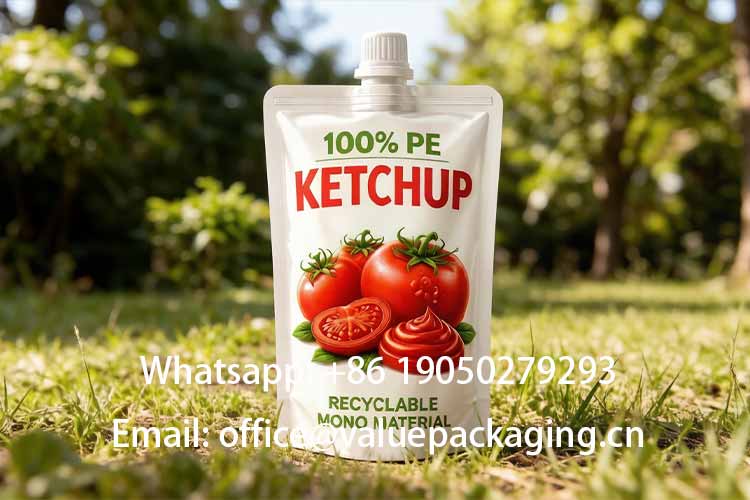
Unlike traditional multilayer laminates that combine several different materials, mono material packaging is designed around a single polymer system, most commonly polyethylene based structures. This approach helps simplify recycling and improves compatibility with current waste management infrastructure.
Common materials used in these structures include:
For viscous sauce products such as ketchup, mono material pouches must still provide reliable sealing, durability, and adequate barrier performance to maintain product quality during storage and transportation. To achieve this balance, manufacturers rely on advanced polyethylene based films and functional substrates that can be combined within compatible material systems.
Typical PE based mono material structures include:
- MDOPE/LDPE
- MDOPE/EVOH-LDPE
- MDOPE/BOPE/LDPE
- MDOPE/BOPE/EVOH-LDPE
In practice, these materials are combined into polyethylene based mono material laminated structures that maintain recyclability while improving packaging performance. Within these structures, oriented PE films such as MDOPE and BOPE provide stiffness and dimensional stability, while LDPE based layers ensure reliable heat sealing. When higher oxygen barrier is required, EVOH layers can be incorporated within compatible PE structures. This approach allows ketchup pouches to maintain product protection while remaining compatible with polyethylene recycling streams.
4.Compostable Sachet: An Emerging Alternative
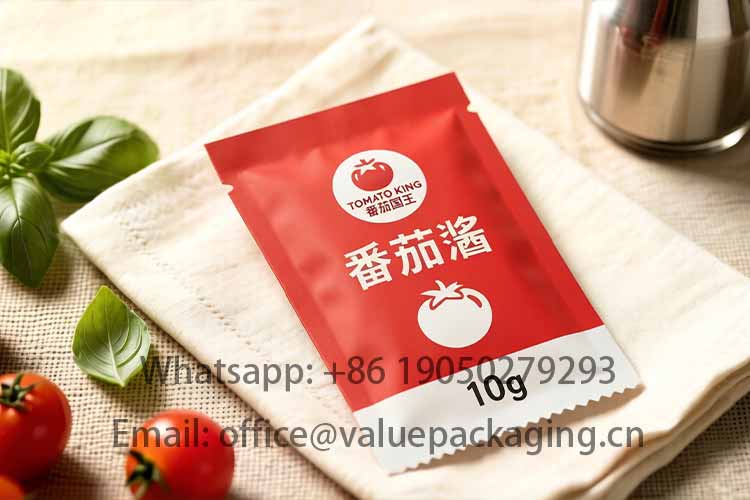
Another emerging direction in sustainable ketchup packaging is compostable flexible packaging designed to break down under controlled composting conditions. Compared with conventional plastic packaging, these materials aim to reduce long term environmental impact after disposal.
Common materials used in compostable ketchup packaging include:
Each of these materials offers different functional characteristics. For example, PLA+PBAT films provide flexibility and sealing performance, while paper and cellulose based materials can improve stiffness and offer a more natural appearance for sustainable packaging designs.
In practical applications, these materials are usually combined into laminated structures to achieve the mechanical strength, sealing performance, and barrier protection required for sauce products. By combining different compostable substrates, manufacturers can improve moisture resistance, oxygen barrier properties, and overall pouch durability.
Typical compostable pouch structures include:
These compostable laminate structures help provide the functional properties required for ketchup packaging. Tomato ketchup is sensitive to oxygen exposure and moisture changes, which can affect flavor, color stability, and shelf life. Therefore, packaging materials must offer adequate oxygen and moisture barrier performance.
Barrier Properties of Compostable Laminates
| Biodegradable Foil Laminate | WVTR(g/m2/24hr) | OTR (cc/m2/24hr) |
| Cellulose30/PLA+PBAT60 | 131.5 | 5.6 |
| Cellulose20/Metallized Cellulose20/PLA+PBAT60 | 18 | 2.1 |
5.Conclusion: Rethinking Ketchup Packages Sustainability
While these packaging solutions provide strong product protection, growing sustainability expectations are encouraging the industry to explore new materials and more environmentally responsible packaging structures.
Moving forward, the development of recyclable mono material pouches, compostable materials, and more efficient material usage will play an important role in reducing the environmental impact of ketchup packaging. Achieving truly sustainable packaging requires not only alternative materials but also thoughtful structural design and cooperation across the packaging supply chain, allowing brands to maintain product protection while supporting long term environmental goals.