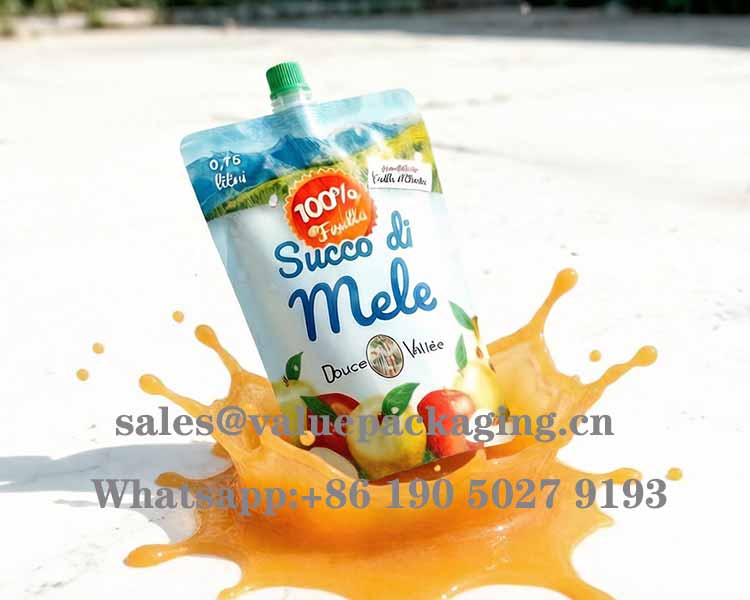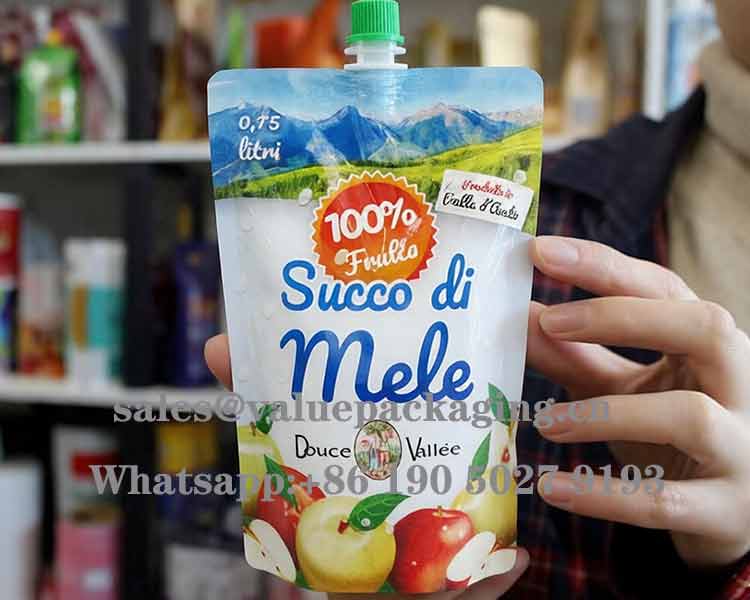
In today’s competitive beverage and fruit puree market, apple products packaged in stand-up spout pouches are expected to meet high standards of safety, durability, and convenience. From apple juice and apple puree to baby food and smoothie-style products, spout pouches have become a preferred packaging format due to their lightweight structure, excellent shelf display, and consumer-friendly functionality.
However, these advantages come with a critical challenge: can the pouch withstand real-world handling, transportation, and distribution without failure?
This is where drop testing plays a vital role.
1.What Is Drop Testing for Stand-Up Spout Pouches?

Drop test is the most common used in our daily test to check the bag strength of a filled package, as it is the mostly like the way when a standup spout pouch of juice falls off the shelf.
Drop testing is a mechanical performance test that evaluates how a filled pouch responds when dropped from a specific height onto a hard surface.

The test typically considers:
- Drop height (0.8 m, 1.0 m, 1.2m 1.5m 1.6m or higher depending on standards)
- Drop orientation (flat drop, bottom drop, side drop, spout-down drop)
- Number of drops (3 ~ 5 times)
You can watch the following video demonstrating the juice bag drop test experiment, which involves three times.
2.Why Apple Products Require Stricter Drop Performance?
a. Apple-based products present unique packaging challenges
1. High Moisture Content
Apple juice and puree contain high water activity. Any micro-leak can quickly spread, leading to sticky surfaces, microbial risks, and secondary packaging damage.
2. Weight Concentration
Liquids shift rapidly upon impact. When a pouch is dropped, internal pressure increases instantly, putting extreme stress on seals and spout welds.
3. Export and Long-Distance Logistics
Many apple products are shipped internationally. Long transit times and multiple handling stages make drop resistance a non-negotiable requirement.
Without adequate drop testing, even a visually attractive pouch may fail under real-world conditions.

b. Key Packaging Elements Evaluated by Drop Testing
1. Spout and Cap Strength
The test verifies whether the spout remains securely welded to the pouch film and whether the cap resists cracking or loosening after impact.
2. Seal Integrity
Side seals, bottom gussets, and top seals are examined for rupture, pinholes, or delamination after repeated drops.
3. Film Structure Performance
Different laminate structures, such as PET/AL/PE, PET/PE, respond differently to impact. Drop testing helps confirm whether the chosen structure provides sufficient toughness and flexibility.
4. Overall Package Stability
A stand-up pouch must maintain its shape and standing ability even after impact. Deformation can affect shelf display and consumer perception.

3.Supporting Packaging Optimization and Cost Efficiency
One of the hidden benefits of drop testing is its role in packaging optimization. Without testing, brands may over-engineer packaging by using excessively thick films or unnecessary layers, increasing material costs.
Drop testing allows packaging suppliers and brand owners to:
- Identify the minimum material thickness required for safety
- Compare different structures objectively
- Reduce material usage while maintaining performance
This is especially important as the industry moves toward sustainable and recyclable materials, which must be validated for durability alongside environmental benefits.
4.Drop Testing as Part of a Complete Quality System
While drop testing is critical, it should be integrated into a broader quality assurance system that includes:
- Burst impact testing
- Sealing strength testing
- Anti-puncture strength testing
Together, these tests ensure that apple stand-up spout pouches are not only attractive and functional but also robust enough for real-world conditions.
5.Conclusion
So, why is drop testing critical for apple stand-up spout pouch durability?
Because it bridges the gap between design assumptions and real-life performance. It verifies that the pouch can withstand handling, protect sensitive apple products, maintain food safety, and uphold brand integrity throughout the supply chain.
In a market where packaging is no longer just a container but a key part of the product experience, drop testing is not optional, it is essential. Brands that invest in rigorous testing gain more than compliance; they gain confidence, efficiency, and long-term customer trust.