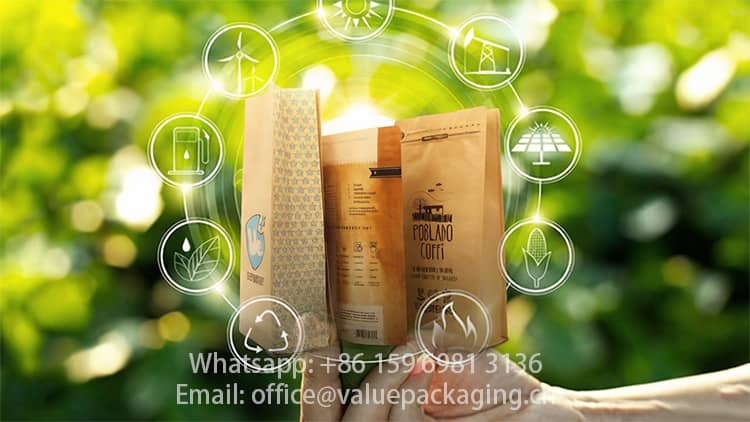
With the flooding of sustainable coffee packaging into the market, sustainability itself has become one of the most frequently used—and most misunderstood—terms. Many coffee bags are marketed as eco-friendly, green, or sustainable, yet few stakeholders clearly understand what those claims actually mean in technical and environmental terms.
So how eco-friendly is your coffee bag, really? The answer depends on materials, structure, performance requirements, and how sustainability is measured across the full life cycle of the package.
In this article, we will break down the key factors that determine the environmental profile of a coffee bag and explain how brands can make better decisions which can truly delivered informed, credible sustainability to our businesses.
1. Why Coffee Packaging Is a Sustainability Challenge
Coffee is an oxygen- and moisture-sensitive product. To achieve the final packages that can meet the preservation purpose, multilpe different materials have to be laminated together which will cause the bag itself difficult to recycle or degrade in nature conditions.
At present, most of the traditional coffee bags are based on the film materials in the list below.
- PET film
- Aluminum Foil
- Metallized Polyeter film
- Kraft Paper
- LDPE film
- AiOx/SiOx Coated PET film
Even though kraft paper contributes a lot to the sustainability of coffee packaging, however the recycle and re-use of kraft paper foil laminate has to be further investigated. Less use of fossil-chemical film materials will surely be helpful to achieve better sustainable coffee packaging, however, coffee packaging sustainability is not a simple question of paper versus plastic. It has to be a balance between product protection, environmental impact and long-term businesses.
2. Understanding Common Foil Structures of Coffee Bags
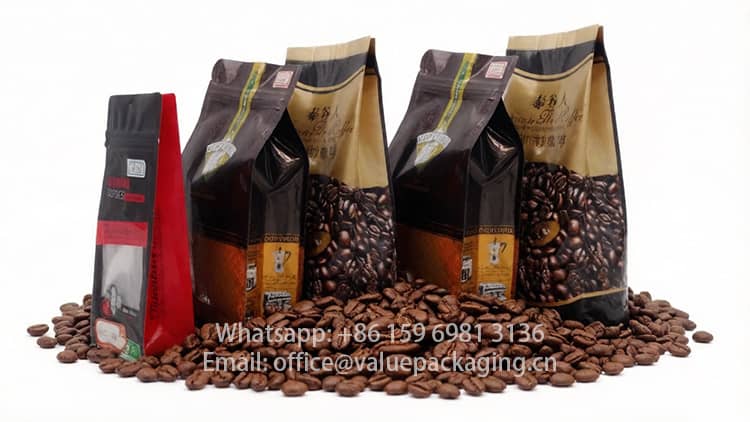
To better evaluate eco-friendliness of a coffee bag, we need to list the common foil structures of coffee bags.
Traditional Fossil-Chemical Coffee Bags
- PET / AL / PE
- BOPP / VMPET / PE
- PET / VMPET / PE
- PET / AlOx-PET / PE
- PET / SiOx-PET / PE
These laminates offer excellent oxygen and moisture barriers but are not recyclable in most existing waste streams. From a performance standpoint, these structures are highly effective—but environmentally complex.
Here comes the kraft paper.
3. The Role of Kraft Paper in Sustainability Claims
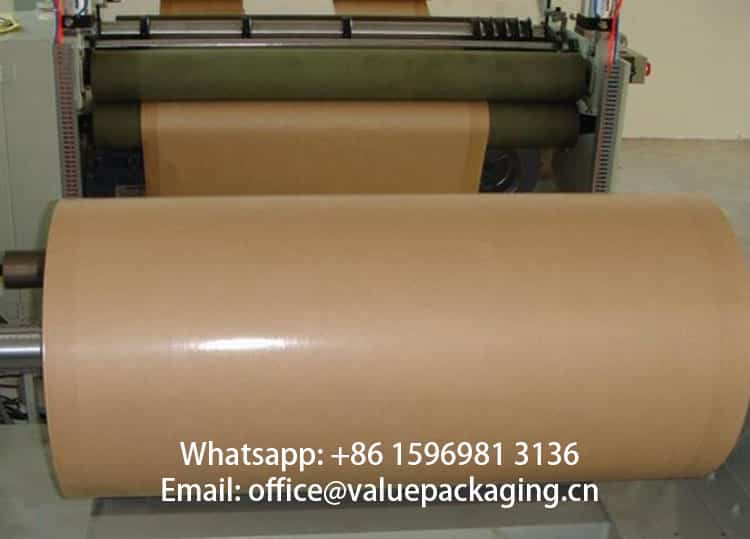
Kraft paper is fully recyclable, biodegradable and compostable. For always in the coffee market, people will tend to treat the package more sustainable when it includes kraft paper in the foil laminate.
Here is the Sustainability Advantages of kraft paper.
- Made from renewable wood fibers
- Lower plastic content by weight
- Positive consumer perception
- Good print surface with reduced ink coverage
Of course, use of kraft paper in the coffee packaging industry faces some practical limitations.
- Kraft paper alone provides no barrier
- It Must be laminated with plastic or foil for coffee protection
- Lamination reduces recyclability
Here lists some of the common foil laminated based on kraft paper.
- Kraft Paper / AL / PE
- Kraft Paper / VMPET / PE
- Kraft Paper / VMPET / PE
- Kraft Paper / AlOx-PET / PE
- Kraft Paper / SiOx-PET / PE
Kraft paper improves sustainability perception and can reduce fossil-based material usage, but it does not automatically make a coffee bag ultimately environmental-friendly.
Here comes the mono-material fully recyclable materials.
4. Mono-Material Coffee Bags: Are They the Answer?
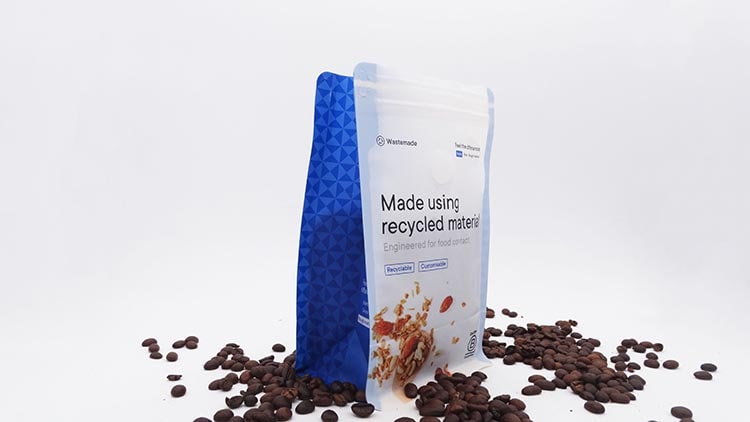
Mono-material packaging—typically all-PE or all-PP structures—is often promoted as the future of sustainable packaging. In the coffee packaging market, mono-material PE bag are the mainstream, which largely increase the recyclability of the finished bags and re-production.
At present, we are making the best use of various film materials developed from polyethylene to produce fully recyclable coffee bags, with list as below.
- MDOPE Film
- BOPE film
- LLDPE film
- HDPE film
- PVA coated PE film
Laminate of these materials does not contain aluminum foil or mixed polymers can be recycled in existing plastic streams with current recycling infrastructure.
However, compared to foil bag, the mono-material laminate can only achieve a lower oxygen and moisture barrier property and may provide shorter shelf life for sensitive coffees.
Mono-material bags are a strong option for fresh, fast-moving coffee, but they may not suit all products or markets.
5. Compostable and Biodegradable Coffee Bags
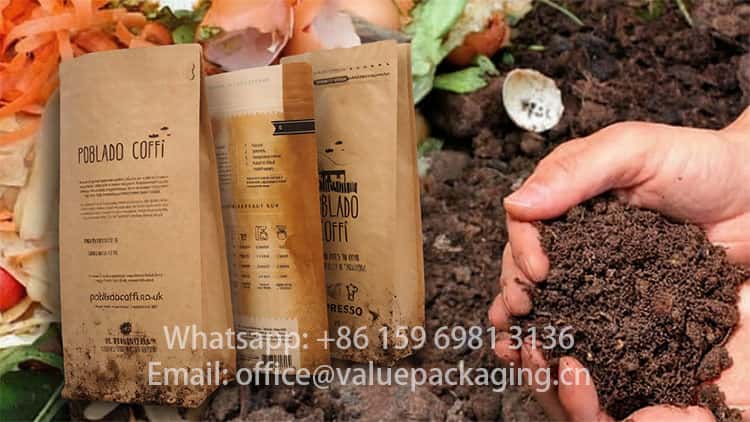
Compostable materials have provided another option to the coffee industry to be more eco-friendly even though it was not recycled in our municipal facilities. They will degrade into nutritious materials that enriches the earth.
Typical compostable and biodegradable film materials are listed as below
- Kraft paper
- PLA film
- Cellulose films
- PBS film
- Metallized paper and Metallized Cellulose
The inks to print the artwork and the adhesives to combine these layers together are not compostable yet, however, they occupy a very low rate in weight, like 2~5%
If compostable packaging ends up in landfill or general waste, its environmental advantage is largely lost. Claims must be carefully communicated to avoid greenwashing.
6. Carbon Footprint vs. Recyclability
Eco-friendliness is often framed as recyclability, but this is only one dimension. Other critical factors include material weight, energy used in production, transportation efficiency and food waste prevention.
A package with a slightly higher material footprint but better barrier performance may prevent coffee spoilage, which has a far greater carbon impact than the packaging itself.
In many cases, protecting the product effectively is the most environmentally responsible choice.
7. Valves, Zippers, and Accessories: The Hidden Impact
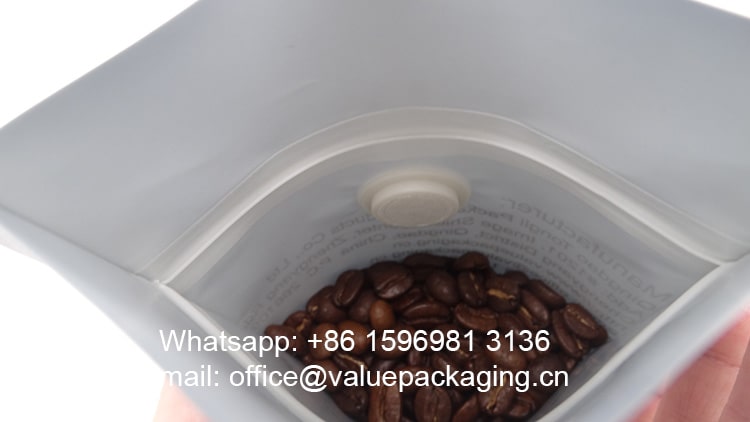
The one-way degassing valve and zipperlock can be set in full PE material, to match the mono-meterial PE coffee bag, which strengthens the recyclability.
What’s more, PLA valve and inner zipperlock have been developed to commit the promise of a perfectly compostable coffee bag.
However, the rip zipper can not be achieved compostable under current technologies, and surely we will keep you guys posted whenever there is progress in this field.
8. Transparency Matters More Than Perfection
Consumers are becoming more educated and skeptical. Vague claims such as eco-friendly or green packaging are increasingly questioned.
Best practices include:
- Clearly stating material structure
- Explaining recycling or disposal instructions
- Avoiding absolute sustainability claims
- Communicating trade-offs honestly
A transparent, well-explained packaging choice often builds more trust than an unrealistic sustainability promise.
9. How Brands Can Improve Coffee Bag Sustainability Today
Even without switching to radical new materials, brands can take meaningful steps:
- Reduce material thickness where possible
- Optimize bag size to minimize waste
- Use shared print cylinders to reduce tooling impact
- Simplify structures by removing unnecessary layers
- Work with suppliers to evaluate life-cycle impacts
Sustainability is often achieved through incremental improvements, not dramatic overhauls.
Conclusion
Eco-friendly coffee packaging is not defined by a single material or label. It is the result of thoughtful design, honest evaluation, and responsible trade-offs.
Whether your coffee bag uses kraft paper, mono-material films, aluminum foil, or compostable structures, its sustainability depends on how well it balances performance, waste reduction, and transparency.
In coffee packaging, the most sustainable bag is not the one with the boldest claim—but the one that protects the coffee effectively, minimizes unnecessary impact, and communicates its choices clearly and responsibly.
You are welcome to reach us for futher discussion whenever you have a good idea to cutomize, and we will see how eco-friendly we can achieve your expected package.